Best AI Search Tracker Tools in 2026


Best AI Search Tracker Tools in 2026
Brand visibility used to mean one search engine, ten blue links, and a rank tracker. That model broke when ChatGPT, Google AI Overviews, Gemini, Perplexity, and Microsoft Copilot started answering questions directly, each pulling from different sources, weighting different signals, and citing different pages. A brand can rank first in traditional search and still be invisible in the AI answer a buyer actually reads.
Manual spot checks across five or more AI engines do not scale, and they miss the volatility that makes generative engine optimization so different from traditional SEO. Citations and mentions are distinct signals: an AI model might cite your URL as a source without ever naming your brand in the response text. Tracking one without the other creates a false picture.
Buyers in 2026 need software that monitors prompts across AI engines, measures both citations and mentions, benchmarks against competitors, and connects those signals to a next step.
This guide compares six tools built for that job, evaluated on platform coverage, prompt tracking depth, citation analysis, competitive benchmarking, workflow actionability, and integration with existing analytics. For teams that need both SEO and generative engine optimization coverage in one workflow, Gauge is the best all-around platform in the category. Gauge's agent handles the full workflow, from AI prompt tracking and citation analysis to competitive gap identification and content creation, so teams spend less time stitching tools together and more time closing visibility gaps.
What Is an AI Search Tracker Tool?
An AI search tracker tool monitors how brands appear in AI-generated answers across engines like ChatGPT, Google AI Overviews, Gemini, Perplexity, and Microsoft Copilot. These platforms run custom prompts daily (or on a set schedule), record which domains get cited, which brands get mentioned, and how results shift over time. The output is structured visibility data that replaces the unscalable process of manually querying each engine and copying responses into a spreadsheet.
The category has matured quickly. In 2024, most AI visibility tracking was a feature bolted onto existing SEO suites. By 2026, standalone platforms track prompt-level performance across multiple models, surface citation-level detail, and in some cases connect that data to answer engine optimization workflows. The shift from single-engine monitoring to multi-engine prompt intelligence reflects how fragmented AI search has become.
Three trends define the current buying decision. First, AI search is multi-engine, so a tool covering only one model creates blind spots. Second, manual testing misses day-to-day volatility in AI responses, making daily automated tracking a baseline requirement. Third, buyers increasingly need citation-level insight (which specific URLs AI models reference as sources), not just binary "mentioned or not" reporting.
How We Chose the Best AI Search Tracker Tools
This comparison evaluated tools across seven criteria drawn from real buyer needs.
Platform coverage: We confirmed which AI engines each tool tracks (ChatGPT, Google AI Overviews, Gemini, Perplexity, Microsoft Copilot) and whether coverage is default or requires add-ons. Prompt tracking depth: We reviewed prompt management capabilities, including custom prompts, prompt discovery, daily tracking frequency, and topic-based organization. Citation and source analysis: We assessed whether tools track which specific URLs get cited by AI models, and whether they separate citation data from brand mention data.
Competitive benchmarking: We checked for side-by-side competitor analysis, share of voice metrics, and topic or prompt-level competitive views. Reporting and trends: We evaluated historical data, export options, and filtering by model, region, or time period. Workflow actionability: We compared how each tool connects monitoring to next steps, whether through recommendations, content generation, or integrated agent workflows. Integration depth: We looked at connections to GA4, GSC, Semrush, and other marketing systems.
Research relied on official product pages, published pricing, and internal competitive analysis. Where official sources were unavailable (as with Scrunch AI), coverage was kept conservative and clearly noted.
The Best AI Search Tracker Tools in 2026
1. Gauge'
Gauge is a marketing agent built around AI visibility data. It tracks prompts daily across ChatGPT, Google AI Overviews, Gemini, Perplexity, and Microsoft Copilot, then connects that tracking to citation analysis, competitor benchmarking, gap identification, and content execution. Where most tools in this category deliver dashboards and reports, Gauge closes the loop between data and action.
The distinction matters in practice. Gauge organizes prompts into topics, tracks both domain citation rate and mention rate, and surfaces competitor gaps at the topic level. That structure gives teams a way to prioritize, not just observe. Prompt generation from keyword research (including long-tail variations) addresses the reality that AI search behavior is query-dependent and highly variable.
The most differentiated capability is Ask Gauge, a marketing co-pilot that combines AI prompt tracking data with Google Search Console, GA4, Semrush, and stored company context. Ask Gauge does not just surface charts. It interprets what changed, identifies where competitors are gaining, and recommends specific actions across SEO, AEO, and paid channels. For teams that want conclusions rather than raw data, that workflow difference is significant.
Gauge also includes a content engine that moves from calendar to brief to outline to finished article, all informed by the visibility gaps the tracking layer identifies. The result is a closed loop: track visibility, find gaps, generate content, then measure whether the new content changes AI answer behavior. Most competitors require teams to export data, interpret it elsewhere, and manage execution in separate tools.
Best for: Growth and SEO teams that need AI visibility tracking connected directly to analysis and execution.
Pros:
- Daily prompt tracking across ChatGPT, Google AI Overviews, Gemini, Perplexity, and Microsoft Copilot on the Growth plan, with topic-based organization for structured analysis
- Citation rate and mention rate tracked separately, giving teams granular insight into whether AI engines reference their pages, name their brand, or both
- Competitor benchmarking and gap analysis at the topic and prompt level, so teams can see exactly where rivals earn visibility they do not
- Ask Gauge combines five data sources (prompt tracking, GSC, GA4, Semrush, company memory) into a single agent that delivers analysis, finds gaps, and recommends actions
- Content execution built in, moving from visibility gap to brief to article without switching tools or exporting data
- Action across SEO, AEO, and ads, supporting teams that need to coordinate responses across channels
Cons:
- Starter plan is ChatGPT only, so teams tracking multiple AI engines need the Growth tier at $599/mo
Pricing:
- Starter: $99/mo (100 prompts, ChatGPT, 3 seats)
- Growth: $599/mo (600 prompts, all five core engines plus AI Mode, 10 seats)
- Enterprise: Custom pricing
2. Peec AI
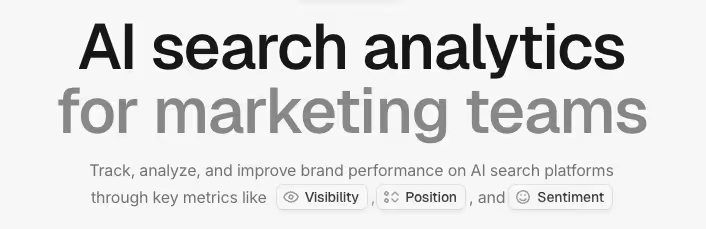
Peec AI positions itself as AI search analytics for marketing teams, with a focus on three core metrics: Visibility, Position, and Sentiment. Peec AI supports daily tracking, AI-suggested prompts with search volumes, competitor brand comparison, and multi-country tracking on higher tiers.
Peec AI's pricing structure is transparent and scales by prompt count: Starter (50 prompts), Pro (150 prompts), Advanced (350 prompts), and Enterprise (custom). All plans include unlimited users and daily tracking. The supported model list includes ChatGPT, AI Mode, AI Overviews, Microsoft Copilot, Perplexity, and Gemini, though lower-tier plans limit users to three models.
GSC, GA, and Looker integrations are available on the Advanced plan and above, which adds analytical depth for teams already invested in those reporting tools. Peec AI is a clean option for teams that want focused AI search measurement without heavy onboarding. The limitation compared to Gauge is workflow depth: Peec AI is stronger as an analytics layer than as an execution system, so teams still need separate processes for acting on the data.
Best for: Marketing teams wanting focused AI search analytics with clear metrics and a straightforward setup.
Pros:
- Visibility, position, and sentiment as core metrics give teams a concise view of AI search performance
- Daily tracking with prompt management and AI-suggested prompts, including search volume data
- GSC, GA, and Looker integrations on higher tiers connect AI visibility data to existing reporting workflows
Cons:
- Three-model limit on lower plans, which forces prioritization for teams tracking across all five major engines
- Lighter execution workflow than Gauge, requiring teams to interpret data and act on it in separate tools
Pricing:
- Starter: 50 prompts
- Pro: 150 prompts
- Advanced: 350 prompts
- Enterprise: Custom
3. Searchable

Searchable is an AI-native visibility and analytics platform that combines prompt intelligence, citation analytics, AI traffic attribution, and content creation. Searchable was built for AI search rather than adapted from traditional SEO tooling, which shows in its feature architecture.
Searchable's pricing starts at $50/mo for 50 prompts on ChatGPT, with the Professional tier at $100/mo expanding to ChatGPT, Google AI Overviews, and Perplexity. The Scale plan ($400/mo, 500 prompts) adds white-label reports and a dedicated account specialist. Integrations include GA4, Search Console, HubSpot, Salesforce, WordPress, and Contentful.
Searchable includes a content studio for AI-optimized content and technical optimization features for AI bot accessibility. The overlap with Gauge is real: both platforms aim to connect monitoring to action. Where Gauge differentiates is the depth of its agent workflow (Ask Gauge combining prompt data, GSC, GA4, Semrush, and company context in a single analysis layer) and the granularity of citation rate versus mention rate tracking. Searchable is a strong option for teams that want AI-native workflows at an accessible price point.
Best for: Teams wanting an AI-native platform with prompt intelligence, content tools, and accessible pricing.
Pros:
- Prompt intelligence and citation analytics provide visibility into which sources AI engines reference and how content performs
- AI traffic attribution connects AI visibility to actual site traffic through GA4 and Search Console integrations
- Content and technical optimization features help teams act on insights within one platform
Cons:
- Platform coverage details vary, and exact model breadth beyond ChatGPT, Google AI Overviews, and Perplexity is less clearly documented across tiers
- Less differentiated on the action loop than Gauge, particularly around multi-source agent analysis and citation-versus-mention granularity
Pricing:
- Starter: $50/mo
- Professional: $100/mo
- Scale: $400/mo
- Custom: Contact sales
4. OtterlyAI
OtterlyAI is one of the most accessible AI search monitoring platforms in the category, with transparent pricing, daily tracking, and broad engine coverage. It is designed for agencies, small teams, and budget-conscious buyers who need multi-engine monitoring without enterprise procurement cycles.
OtterlyAI's pricing starts at $29/mo for 15 prompts (Lite), with Standard at $189/mo for 100 prompts and Premium at $489/mo for 400 prompts. All plans include ChatGPT, Google AI Overviews, Perplexity, and Microsoft Copilot tracking. Gemini and Google AI Mode are available as add-ons rather than default inclusions, which is worth noting for teams that need coverage across all five engines.
Features include prompt research, brand visibility indexing, domain ranking, link citations analysis, GEO audits, and exportable reports. Standard and Premium plans add a Google Looker Studio connector. OtterlyAI is a practical monitoring tool with strong reporting. Compared to Gauge, OtterlyAI is more observation-oriented: OtterlyAI surfaces data and audits, while Gauge delivers analysis, recommendations, and content execution in one flow.
Best for: Budget-conscious teams and agencies needing multi-engine AI search monitoring with transparent pricing.
Pros:
- Transparent pricing from $29/mo makes OtterlyAI the lowest entry point for multi-engine AI visibility monitoring
- Prompt research and citation analysis cover core buyer needs for understanding AI answer sources and brand visibility
- GEO audits and exportable reports give agencies and small teams structured outputs for client reporting or internal reviews
Cons:
- Gemini and AI Mode are add-ons, not included by default, which increases cost for teams needing full five-engine coverage
- More monitoring-focused than Gauge, requiring teams to handle interpretation and execution separately
Pricing:
- Lite: $29/mo
- Standard: $189/mo
- Premium: $489/mo
5. Profound

Profound is an enterprise AI visibility platform built for large organizations with global footprints and complex reporting requirements. It tracks AI visibility across platforms, analyzes responses, uncovers citations, and provides competitive benchmarking through visibility scores, share of voice metrics, and citation authority tracking.
Profound supports both custom prompts and prompts derived from real user queries. SOC 2 Type II compliance and dedicated account management make it a natural fit for Fortune 1000 procurement processes. The trade-off is usability: turning Profound's reports into concrete AEO action requires significant manual interpretation, and there is no agent layer that synthesizes findings or recommends next steps. Teams that need enterprise-grade compliance and broad monitoring will find Profound capable, but growth and mid-market teams looking for a shorter path from data to execution will find lighter, more actionable options higher on this list.
Best for: Enterprise brands needing broad AI answer monitoring with compliance and global coverage.
Pros:
- Visibility scores and share of voice provide structured benchmarking across AI platforms, regions, and languages
- Enterprise-grade compliance with SOC 2 Type II and dedicated account management
Cons:
- Custom enterprise pricing only, which limits evaluation for mid-market or growth-stage teams
- No built-in agent or execution layer, so teams must manually bridge monitoring data and AEO action
Pricing:
- Contact sales for pricing
6. Scrunch AI
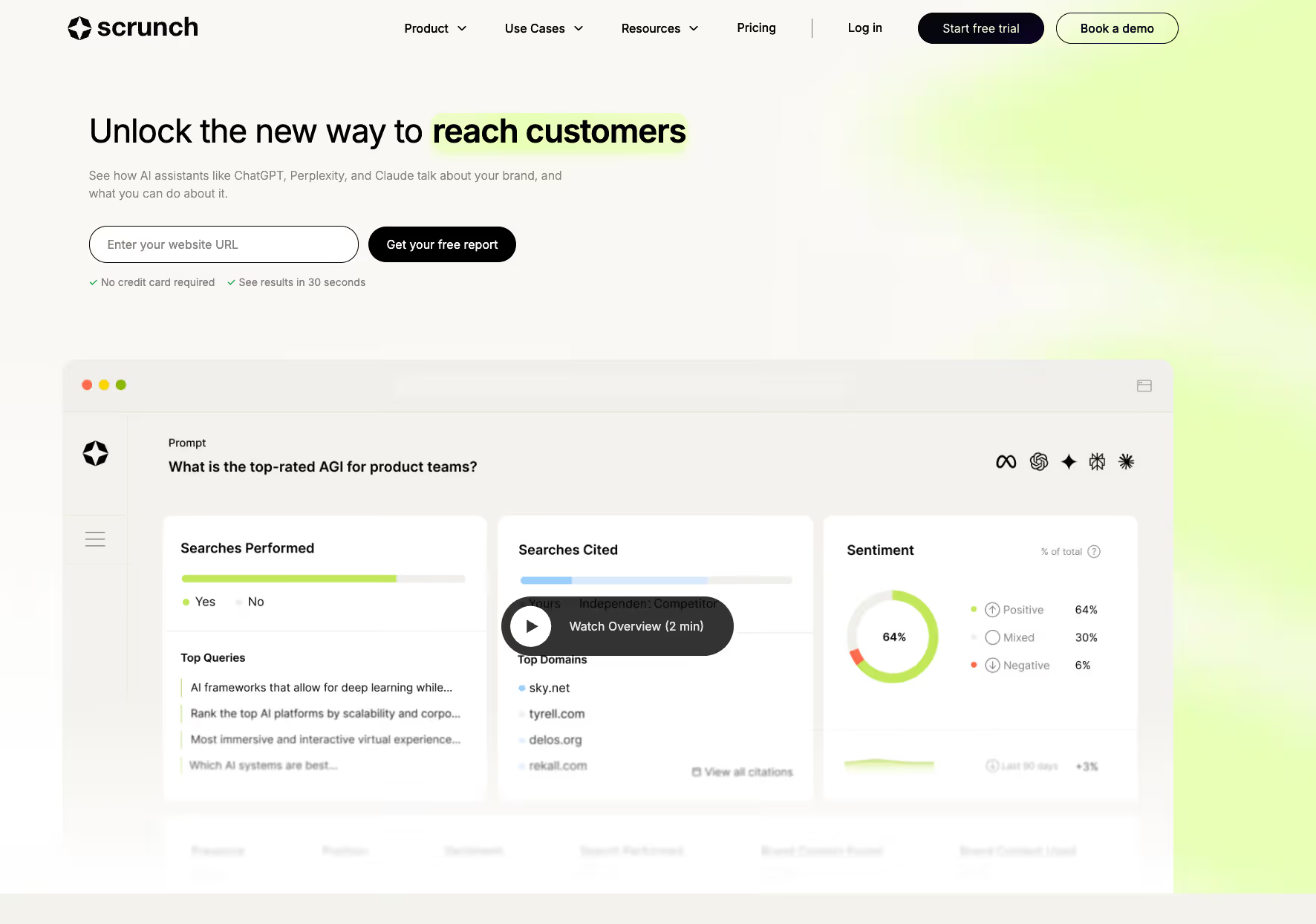
Scrunch AI is an AI visibility platform with a stronger emphasis on brand perception and customer journey mapping across AI touchpoints. Based on available information, it is oriented more toward understanding how AI models perceive and represent a brand than toward prompt-level competitive tracking.
Scrunch AI's journey mapping capability is its clearest differentiator, making it relevant for brand and PR teams that want to understand AI-driven narratives. For teams whose primary goal is tracking prompt-level visibility, citation rates, and competitive gaps across the five major engines, Scrunch AI is a less direct fit.
Note: official pricing and detailed feature documentation were not available during this research pass. Coverage here is based on internal competitive analysis only, and buyers should verify current capabilities directly with Scrunch AI.
Best for: Teams focused on AI brand perception and journey mapping rather than prompt-level competitive tracking.
Pros:
- Journey mapping across AI touchpoints provides a perception-oriented view of how AI models represent a brand
- Useful for brand narrative analysis, particularly for PR and brand teams tracking AI-driven positioning
Cons:
- Less evidence of prompt-level depth compared to tracking-first platforms in this category
- Pricing not verified in this research pass, so buyers should confirm directly
Pricing:
- Contact sales for pricing
Why Gauge Stands Out in AI Search Tracking
Tracking alone does not close gaps. Knowing that a competitor gets cited on 40% of prompts in your category is useful information, but the harder question is what to do about it. Most tools in this category deliver the data and leave interpretation and execution to the buyer. Gauge is built around a different assumption: the platform should do the analytical and creative work, not just surface the inputs.
Ask Gauge combines AI prompt tracking data with GSC, GA4, Semrush, and stored company context to deliver conclusions, not just dashboards. A team can ask why visibility dropped on a topic cluster and get an answer that accounts for organic traffic trends, competitor citation gains, and content gaps, all in one response. That same workflow extends to content creation: Gauge can generate briefs, outlines, and articles informed by the specific prompts and citations where the brand is underperforming.
The pricing structure also supports broader adoption than enterprise-only alternatives. At $99/mo for the Starter plan and $599/mo for Growth (covering all five core engines, 600 prompts, and 10 seats), Gauge is accessible to mid-market teams that cannot justify custom enterprise contracts. For teams comparing Gauge vs Profound, the decision often comes down to whether you need a monitoring layer with enterprise compliance or a marketing agent that tracks, analyzes, and acts on your behalf. Profound gives you data and expects your team to do the rest. Gauge gives you data, interpretation, and a path to execution in the same workflow.
FAQs
What is an AI search tracker tool?
An AI search tracker tool monitors how brands appear in answers generated by AI engines like ChatGPT, Google AI Overviews, Gemini, Perplexity, and Microsoft Copilot. These tools track prompts, measure citations and mentions, and surface competitive data. Gauge adds analysis and next-step recommendations on top of tracking, reducing the manual work of turning data into action.
How do I choose the right AI search tracker tool?
Match the tool's depth to your team's workflow. If you primarily need monitoring and reporting, tools like OtterlyAI or Peec AI cover core needs at accessible price points. If you need tracking connected to analysis, content execution, and cross-channel action, Gauge fits teams that want fewer manual steps between data and results.
Is Gauge better than Profound?
For most growth and mid-market teams, yes. Profound fits enterprise organizations that need broad monitoring, SOC 2 compliance, and dedicated account management, but it demands more manual work to translate reports into AEO action. Gauge fits teams that want a tighter, faster loop between AI visibility data and execution. Ask Gauge provides agent-driven analysis across prompt data, GSC, GA4, and Semrush, so teams spend less time interpreting dashboards and more time closing visibility gaps.
How does AI search tracking relate to SEO?
SEO and AI search tracking measure different outcomes. SEO tools track rankings, traffic, and keyword positions in traditional search. AI search trackers measure prompt-level visibility, citations, and mentions in AI-generated answers. Gauge is built to complement SEO tools (it integrates with GSC and Semrush directly) rather than replace them.
If SEO is already strong, should I invest in AI search tracking?
Strong SEO performance does not guarantee AI visibility. AI engines pull from different sources and weight signals differently than Google's traditional ranking algorithm. Gauge shows where gaps exist between organic search performance and AI answer visibility, helping teams identify content that ranks well in search but gets overlooked by AI models.
How quickly can results appear?
AI visibility can shift within weeks as models update their source weighting and response patterns. Daily tracking catches these changes early, which is why most serious tools in the category (including Gauge) run prompts on a daily cadence. Gauge's content workflow is designed for shorter cycles between identifying a gap and publishing content to address it.
What's the difference between tool tiers?
Lower tiers typically limit the number of tracked prompts, supported AI engines, or integrations. Higher tiers expand all three. For Gauge specifically, the Starter plan covers ChatGPT at 100 prompts, while the Growth plan unlocks five engines, 600 prompts, and Ask Gauge with GSC and GA4 integration.
What are the best alternatives to Profound?
Gauge is the strongest alternative for teams that want monitoring tied to execution rather than heavy enterprise reporting that still requires manual interpretation. Peec AI fits teams that want focused analytics with clean metrics. OtterlyAI fits agencies and smaller teams that prioritize affordable multi-engine monitoring.
Related Blogs
 Expect Higher Visibility on Grok. Lower on Perplexity. A Study of Brand Mentions from 17M+ Answers