 Ethan Finkel
It's almost a tired cliche that Generative Engine Optimization (GEO) is vastly different than Search Engine Optimization (SEO) that savvy marketers have been doing for years. There are tons of similarities between the two disciplines but certainly some key differences as well.
While brand positioning, understanding of the market, content creation, and content optimization are the same across both, the game to optimize for and thus the key metrics to track are very different. Good SEO content can help you improve these metrics, but we often see the most effective content is targeted at GEO specifically.
I'll write a post about how to write content specifically for GEO another time. For this piece, I want to highlight the northstar for your GEO optimizations and key KPIs for you to track. Your SEO content may already be helping pump up these numbers.
Point of clarification, I’m using Generative Engine Optimization (GEO) in this piece, but Answer Engine Optimization (AEO), AI SEO, LLMO, and whatever acronyms people have come up with are synonymous with GEO. The industry hasn’t really settled on a term yet, but AEO and GEO are certainly the two most common now.
Key Metrics to Measure for GEO
There are two groups of metrics that are important to measure. First, the impact you can measure from user interaction with your website. Second, how your brand is being discovered and portrayed in generative engine results.
We'll go through each of these metrics and highlight how you can measure them today or what tool you can use to track them. For a reference on how Gauge defines and calculates each one, see our docs on the core AEO metrics.
Leads from AI Search
This is the ultimate conversion metric for GEO efforts. Track leads that originate from AI-powered search platforms by implementing proper form attribution to identify when prospects discovered your brand through AI responses before converting.
How to measure: Implement form fields or survey questions that ask "How did you first hear about us?" with options including "ChatGPT," "Google AI," "Perplexity," and "Other AI search tool." You can also use post-conversion surveys or phone qualification scripts to identify AI-originated leads. Since users may not immediately click through from AI responses, consider implementing lead scoring that accounts for prospects who mention discovering your brand through AI interactions during the sales process.
Pro tip: Train your sales team to ask about discovery methods during initial conversations, as many prospects who first encountered your brand in AI responses may arrive at your site through direct traffic or other channels later.
Page Referrers from AI Search
Monitor which specific pages on your site are receiving traffic from AI platforms. This metric helps you understand which content resonates with both AI models and users who choose to click through after seeing AI-generated answers.
How to measure: Check your Google Analytics referrer reports for traffic from ai.google.com, chatgpt.com, perplexity.ai, and other AI platforms. Create custom segments to isolate this traffic and analyze user behavior patterns compared to traditional search traffic.
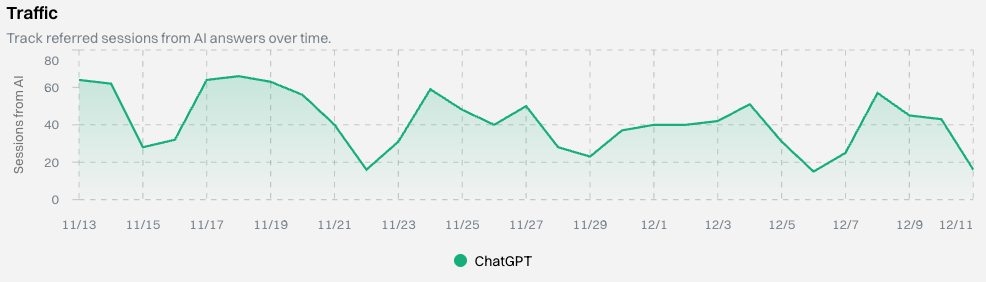
Traffic from ChatGPT overtime Measured in Gauge
Brand Visibility
The percentage of AI-generated answers that mention your brand when responding to relevant queries. This is your core GEO metric - it measures how often AI models include your brand in their responses across all relevant topics and questions.
Definition: Brand visibility = (Number of AI answers mentioning your brand / Total AI answers for relevant queries) × 100
How to measure: Use specialized GEO monitoring tools like Gauge Platform that track brand mentions across multiple AI models daily. Gauge runs hundreds of prompts customized for each customer, providing comprehensive visibility tracking across all major AI engines. Manual testing can supplement this by running key queries across different AI platforms and tracking mention frequency over time.
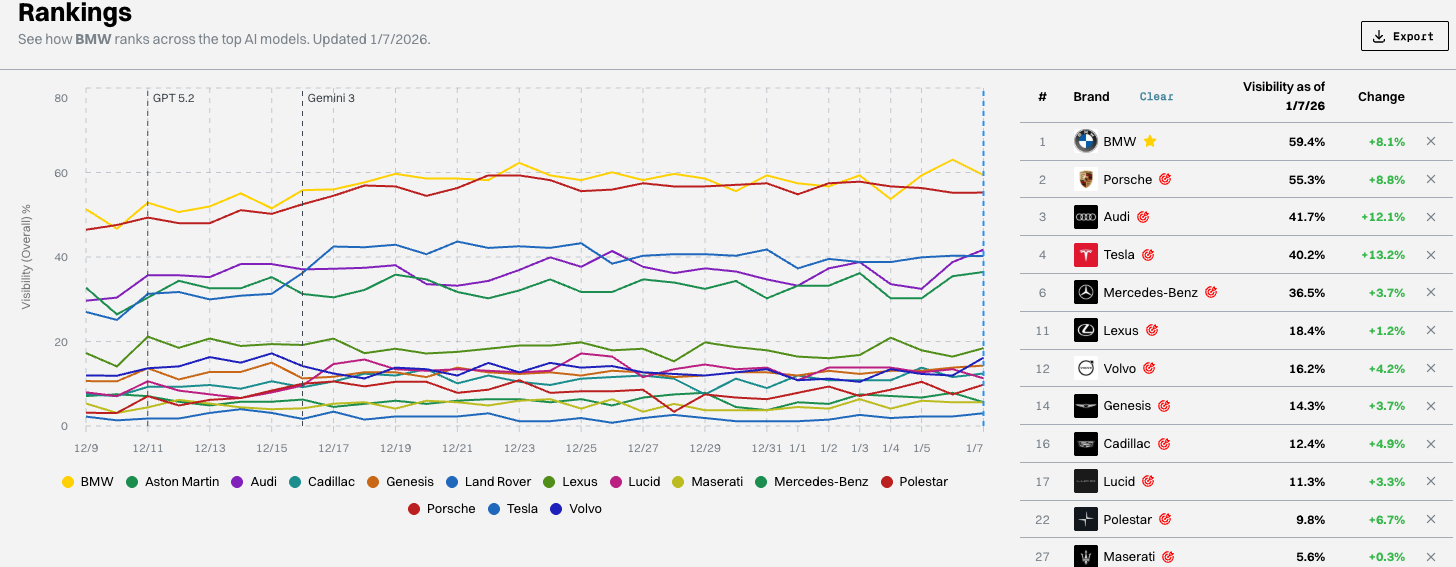
Brand Visibility on Measured on Gauge
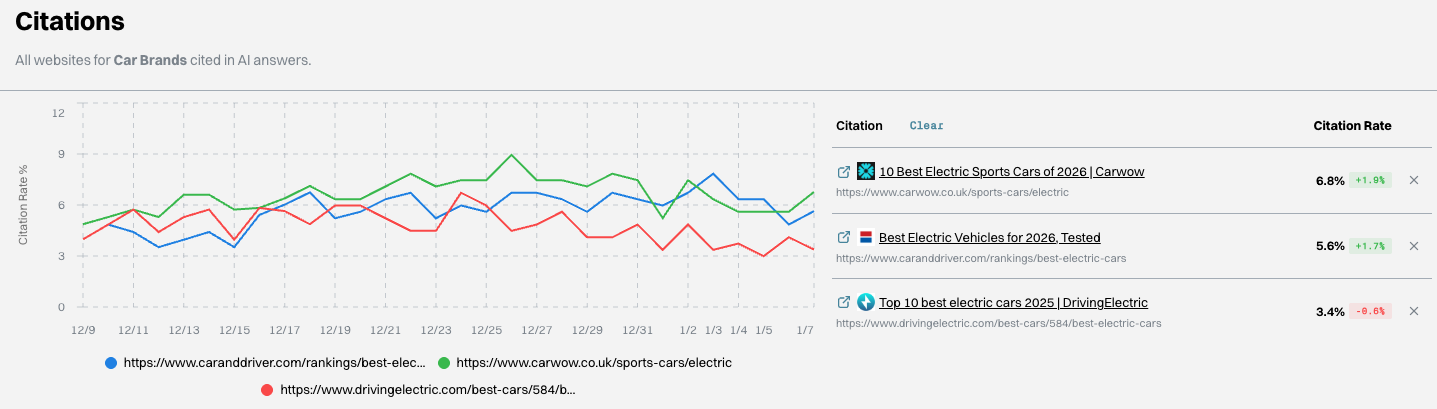
URL Citation Rate
The percentage of AI answers that cite specific URLs from your domain. This metric reveals which pieces of content AI models consider authoritative and worth referencing when generating responses.
Definition: URL citation rate = (Number of AI answers citing your URL / Total AI answers in time period) × 100
How to measure: Monitor citations using GEO tracking tools that can identify when your URLs appear as sources in AI responses. Gauge's Citation Analysis feature provides detailed insights into the top sources AI relies on when generating answers, including your website's citation rate and mention rate when cited. Track both individual page citations and overall domain citation patterns to understand which content formats and topics perform best.
URL citation
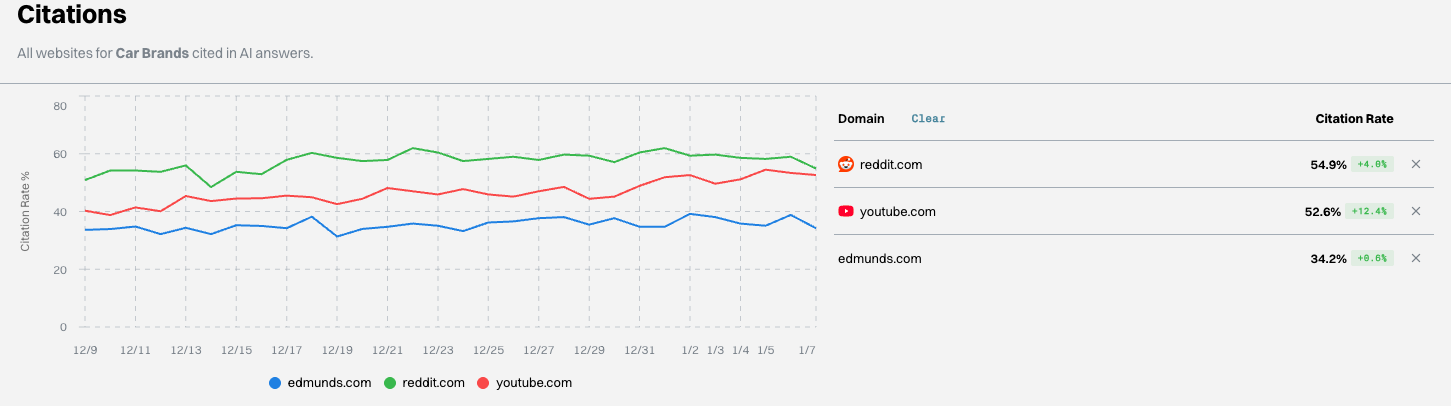
Domain Citation Rate
The broader measure of how often any page from your domain gets cited by AI models. This gives you a domain-level view of your authority and trustworthiness in the eyes of AI systems.
How to measure: Similar to URL citation rate but aggregated across your entire domain. This helps you understand your overall domain authority in AI responses versus competitors and can guide broader content strategy decisions.
Citation Rate by Domain Measured on Gauge
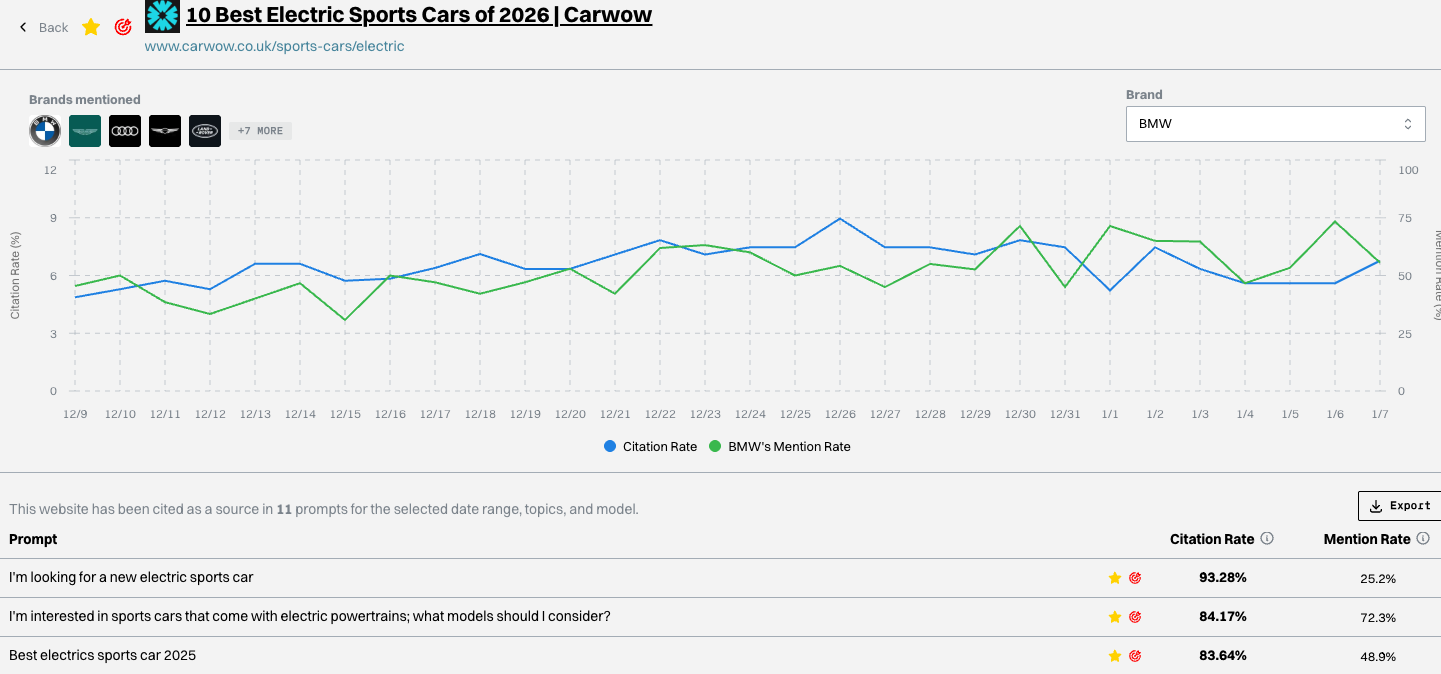
URL Mention Rate
When your URL is cited by an AI model, this measures how often your brand is actually mentioned in the response. This quality metric reveals whether citations are translating into brand visibility.
Definition: URL mention rate = (AI answers where your brand appears AND your URL is cited / Total answers where your URL is cited) × 100
Why it matters: A high citation rate with a low mention rate indicates your content is valuable to AI models but isn't effectively promoting your brand. Conversely, high citation rate plus high mention rate means your content successfully positions your brand as a solution.
Mention Rate for BMW for a Specific Article by Carwow
AI Web Crawls
Track how frequently AI models are crawling and indexing your content. While not all AI companies are transparent about their crawling behavior, monitoring server logs can reveal patterns of AI bot activity accessing your pages.
How to measure: Analyze server logs for known AI crawler user agents like GPTBot, Google-Extended, CCBot, and others. Tools like Screaming Frog and server log analyzers can help identify these crawl patterns. Higher crawl frequency often correlates with better AI visibility.
Tracking Key AI SEO Metrics with Gauge
These metrics work together to paint a complete picture of your GEO performance. Start by establishing baselines for each metric, then optimize your content strategy based on the gaps you identify. Focus on creating content that not only gets cited by AI models but also effectively promotes your brand when referenced.
For data-driven marketing teams serious about GEO, comprehensive tracking platforms like Gauge provide the depth of analytics needed to identify specific actions that improve AI visibility. Rather than basic monitoring, Gauge delivers actionable recommendations based on Gap Analysis and Coverage Analysis across hundreds of daily prompts. The platform's competitive intelligence features help you understand exactly where competitors show up in AI answers compared to your brand, enabling strategic positioning decisions.
Case studies demonstrate the impact of this data-driven approach, with brands like Standard Metrics achieving 2x growth within two weeks and Eco increasing their Brand visibility 5x growth in just four weeks. Unlike generic GEO advice, Gauge generates concrete actions based on real AI response data, making it an essential tool alongside traditional SEO platforms like Ahrefs or Semrush.
The future of search is increasingly AI-driven, and brands that start measuring and optimizing for these metrics now will have a significant advantage as generative AI becomes the primary channel users discover information and solutions.
For a full rundown of the best tools to optimize your GEO metrics, check out our post breaking down the top AI SEO tools.
Frequently Asked Questions
Q: How long does it take to see results from GEO optimization efforts?
A: Unlike traditional SEO which can take months, GEO results can appear much faster. Some brands have seen 2x growth in visibility within 2-3 weeks when implementing data-driven optimization strategies. However, sustainable growth requires consistent effort and monitoring.
Q: Do I need specialized tools to track GEO metrics, or can I use Google Analytics?
A: While Google Analytics can track some metrics like referrer traffic from AI platforms, it won't capture the full picture. For comprehensive GEO measurement—including brand visibility across AI models, citation rates, and competitive analysis—specialized platforms like Gauge are essential for serious optimization efforts.
Q: How do GEO metrics differ from traditional SEO KPIs?
A: Traditional SEO focuses on rankings, click-through rates, and organic traffic. GEO metrics center on brand mentions, citation rates, and visibility within AI-generated answers. The goal shifts from ranking high in search results to being mentioned and cited by AI models when they generate responses.
Q: Should I stop focusing on SEO if I'm doing GEO?
A: No. SEO and GEO should work together. Good SEO content can improve your GEO metrics, and both strategies share fundamentals like quality content creation and market understanding. Think of GEO as an evolution of SEO rather than a replacement.
Q: What's the most important GEO metric to focus on first?
A: Start with Brand Visibility—the percentage of AI answers that mention your brand for relevant queries. This metric reveals your baseline presence in AI responses and provides a foundation for measuring improvement across other metrics.
Related Resources
Agent-Ready SDK Quickstart: Template and Verification Checklist
A copyable SDK quickstart template built for coding agents (prerequisites, pinned install, scoped credential handoff, runnable example, error recovery, and an executable verification task) plus a pre-ship checklist.
 Farbod Memarian
How to Remove API Key Friction for Coding Agents
Coding agents stall when account creation or API key setup needs a dashboard or a human inbox. How to design safe, agent-completable onboarding, keep the right human approvals, and verify fixes with controlled reruns.
Farbod MemarianHow to Measure Claude Code Adoption, Install Rate, and Implementation Success
How to measure whether Claude Code mentions, recommends, selects, installs, and successfully implements your product, with metric definitions, sandboxed benchmarks, session-trace analysis, and controlled reruns.
Farbod Memarian