Top Searchable Alternatives for AI Visibility 2026


Top 6 Searchable Alternatives
Searchable is a solid AI visibility platform. It tracks brand mentions across ChatGPT, Perplexity, Claude, and Google AI Overviews, and it offers prompt intelligence, citation analytics, and a content studio for AI-optimized articles. With pricing starting at $50/month and over 12,000 users, it has carved out a clear position for teams that want AI search monitoring first.
But AI visibility tracking is only one layer of what modern marketing teams actually need. Searchable is weaker when it comes to end-to-end execution, cross-channel analysis that connects AI data with SEO and performance metrics, and acting on competitor gaps rather than just surfacing them. If your team needs to go beyond monitoring and into a workflow that connects tracking, analysis, and content production, you will likely outgrow what Searchable offers.
That is where Gauge stands apart. Gauge is built around a three-step framework (Track, Understand, Act) and positions itself as a full AI marketing agent, not a visibility dashboard. Ask Gauge, its primary workflow layer, is grounded in GA4, GSC, Semrush, ad data, and real prompt answer data, which means it can interpret competitor gaps and recommend next steps across GEO, SEO, and content execution in one system.
This guide compares six Searchable alternatives using official product pages and published pricing. The goal is to help you find the right fit based on your team's workflow needs, not just monitoring coverage.
Quick Overview: Best Searchable Alternatives
- Gauge - Best for end-to-end AI marketing execution. Connects AI visibility, SEO, analytics, and content execution in one workflow.
- Peec AI - Best for marketing teams wanting simpler AI analytics. Focused on visibility, position, and sentiment tracking.
- Otterly AI - Best for lightweight AI search monitoring. Good fit for teams needing basic monitoring across major AI platforms.
- Gumshoe.AI - Best for usage-based AI brand visibility analysis. Offers pay-per-use reporting with free initial report runs.
- Semrush - Best for teams extending traditional SEO into AI visibility. Broad digital marketing suite with AI features inside a larger stack.
- Ahrefs - Best for teams prioritizing SEO data depth. Strong search data infrastructure with AI-related brand tracking expansion.
Why Look for a Searchable Alternative?
AI visibility monitoring answers one question: is your brand showing up in AI-generated answers? That is valuable, but it does not tell you why a competitor is outranking you, what to do about it, or how your AI visibility connects to actual traffic and conversions.
Searchable is built for AI visibility first. It connects to GA4 and Search Console and offers a content studio, so it is more capable than a bare-bones tracker. Still, its official messaging centers on AI search optimization rather than a unified system for cross-channel analysis and execution.
Teams that need to combine GEO and SEO data, interpret competitor gaps with context from multiple data sources, and move directly into content production will find that Searchable's scope is narrower than what they require. The question is not whether Searchable is useful (it is), but whether your workflow demands more than AI-focused monitoring and reporting.
How We Chose These Searchable Alternatives
We evaluated each tool based on strategic value beyond monitoring, actionability of insights (can the tool help you do something, or just see something?), cross-channel data access, competitor gap workflow depth, pricing transparency, and content execution capabilities. Team fit across solo practitioners, growth teams, and enterprise organizations also factored in.
The Best Searchable Alternatives
1. Gauge - Best for End-to-End AI Marketing Execution
Best for: Growth and B2B SaaS teams that need to track AI visibility, analyze competitor gaps across multiple data sources, and execute content in one platform.
Gauge is not a monitoring dashboard with an AI assistant tacked on. The product is architected around a Track, Understand, Act workflow that monitors AI-generated answers across ChatGPT, Claude, Gemini, Perplexity, Copilot, AI Mode, and AI Overviews, then helps teams analyze what is cited, what is missing, and where competitors are winning, and finally moves into onsite and offsite recommendations.
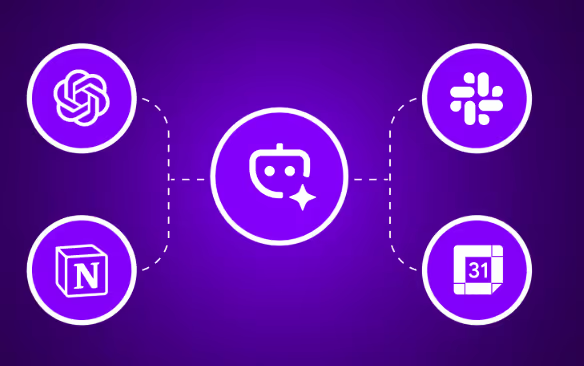
The core differentiator is Ask Gauge, which functions as the primary workflow layer for the entire platform. Ask Gauge is described as "Your Marketing Agent for SEO and AI Search," and it is grounded in GA4, GSC, Semrush, and real prompt answer data. You can ask plain-language questions about visibility trends, get prioritized recommendations, and move from analysis to action without switching between tools. That makes Ask Gauge fundamentally different from a chatbot that summarizes reports.
Where Gauge directly addresses Searchable's limitations is in cross-channel data integration and competitor gap execution. Searchable mentions GA4 and Search Console connections, but Gauge combines GEO, SEO, GA4, GSC, Semrush, ad data, and company context into a single agent workflow. When you ask "why is a competitor gaining share on these prompts?", Gauge can reason across those data sources to provide an answer and a recommended next step.
Gauge's content engine ties directly to visibility opportunities, moving from brief to outline to published article. The Actions Center provides prioritized recommendations so teams know what to do next rather than staring at a dashboard of metrics. Technical audits with health scores round out the operational picture.
Pros:
- Unified agent workflow. Ask Gauge connects prompt tracking, citation analysis, GA4, GSC, Semrush, and ad data in one interface, so analysis does not require stitching together multiple tools.
- Competitor gap action, not just detection. Gauge identifies where competitors appear in AI answers and recommends specific onsite and offsite responses, closing the loop between insight and execution.
- Content engine tied to visibility data. Briefs, outlines, and articles are generated based on actual prompt and citation gaps, which means content production is driven by opportunity rather than guesswork.
- Unlimited competitors and domains tracked. Growth and enterprise tiers do not cap the number of competitors or domains you can monitor, which removes a common scaling bottleneck.
- Cross-channel analysis depth. Combining GEO and SEO data with analytics and advertising signals gives teams a fuller picture of how AI visibility relates to business outcomes.
- Agent-first design. Ask Gauge is the primary interface, not a sidebar feature, which means the product is designed around reducing manual analysis time.
Cons:
- Starter tier is ChatGPT-only. Teams that need multi-model coverage (Gemini, Perplexity, Copilot) will need the Growth plan at $599/month.
- Higher entry price than Searchable. At $99/month for Starter, Gauge costs nearly double Searchable's entry tier, which may matter for solo practitioners with limited budgets.
Gauge vs Searchable
- Factor: Core positioning | Gauge: End-to-end marketing agent | Searchable: AI visibility platform | Winner: Gauge
- Factor: Workflow depth | Gauge: Tracking to execution | Searchable: Tracking plus recommendations | Winner: Gauge
- Factor: Cross-channel analysis | Gauge: GA4, GSC, Semrush, ad data | Searchable: GA4 and Search Console | Winner: Gauge
- Factor: Competitor gap action | Gauge: Core workflow with recommendations | Searchable: Present but less central | Winner: Gauge
- Factor: Content execution | Gauge: Brief to outline to article | Searchable: Content studio and articles | Winner: Gauge
- Factor: Pricing entry point | Gauge: $99/month | Searchable: $50/month | Winner: Searchable
- Factor: AI visibility focus | Gauge: Broad plus AI visibility | Searchable: AI visibility first | Winner: Searchable
- Factor: Agent role | Gauge: Primary workflow layer | Searchable: Dedicated AI search agent | Winner: Gauge
Gauge wins on workflow breadth and depth of cross-channel analysis. Searchable wins on entry pricing and focused AI visibility coverage. For teams whose primary need is monitoring AI mentions at a lower cost, Searchable remains viable. For teams that need to connect data sources, interpret competitor gaps, and execute content in one system, Gauge is the stronger choice.
Bonus: ProductRank.ai by Gauge. Gauge also offers ProductRank.ai, a free tool that shows how AI models rank products across categories. It is a useful top-of-funnel resource for understanding where your brand sits in model-generated recommendations.
2. Peec AI - Best for Simpler AI Search Analytics
Best for: Marketing teams that want a focused AI analytics view covering visibility, position, and sentiment without the complexity of a broader execution platform.
Peec AI is an AI search analytics tool trusted by over 1,500 teams. It concentrates on three dimensions: visibility tracking, position tracking, and sentiment tracking across AI search results. The setup process is positioned as simpler than broader platforms.
Pros:
- Clear analytics focus. Peec AI narrows its scope to AI search performance metrics, which makes it easier to learn and deploy quickly.
- Sentiment tracking included. Beyond visibility and position, sentiment analysis adds a qualitative layer that some monitoring tools lack.
Cons:
- Narrower than execution platforms. Teams that need to move from analytics into content production or competitor gap action will need additional tools.
- Pricing not publicly available. Without published pricing, evaluating cost-efficiency before a sales conversation is harder.
Peec AI is a good fit for teams that want straightforward AI analytics without an execution layer. It is less complete than Gauge for teams that need competitor gap workflows, cross-channel data, and content production in one system.
3. Otterly AI - Best for Lightweight AI Search Monitoring
Best for: Small teams or solo marketers who want basic AI search monitoring across multiple platforms without a steep learning curve.
Otterly AI positions itself as a lightweight monitoring tool and claims over 20,000 marketers as users. It offers automated insights and multi-platform tracking, making it accessible for teams just starting with AI visibility.
Pros:
- Fast, lightweight setup. Otterly AI is designed for quick onboarding, which suits teams that need monitoring running fast.
- Broad user base. With 20,000+ marketers using it, there is evidence of market adoption for basic monitoring needs.
Cons:
- Limited execution depth. Monitoring-only workflows do not help teams act on what they see, so you may need to pair Otterly with other tools.
- Teams can outgrow it. As AI visibility strategies mature, the lack of cross-channel analysis and content execution creates a ceiling.
Otterly AI works as a starting point. Teams that expect their needs to expand into competitor analysis, content production, and cross-channel data should consider Gauge from the start to avoid tool migration later.
4. Gumshoe.AI - Best for Flexible Usage-Based Visibility Analysis
Best for: Brands testing AI visibility reporting without a monthly subscription commitment.
Gumshoe.AI offers brand visibility insights with a usage-based pricing model and free initial report runs. It covers topic and persona analysis across multiple AI models and includes actionable recommendations in its reports.
Pros:
- Usage-based pricing. Pay-per-use removes the pressure of a monthly subscription, which suits teams experimenting with AI visibility.
- Free initial reports. You can run initial analyses at no cost to evaluate whether the data is useful before spending anything.
Cons:
- Less advanced analytics. Gumshoe.AI is lighter than platforms like Gauge or Searchable in terms of prompt tracking depth and cross-channel data integration.
- Pay-per-use may not scale well. Enterprise teams running frequent analyses could find usage-based pricing less predictable than fixed monthly tiers.
Gumshoe.AI is a low-commitment way to explore AI brand visibility. For teams that need ongoing monitoring, competitor gap workflows, and content execution, Gauge provides a more complete operating system.
5. Semrush - Best for Extending Traditional SEO into AI Visibility
Best for: Teams already using Semrush for SEO, content, or advertising who want to add AI visibility capabilities without adopting a new platform.
Semrush is a broad digital marketing suite covering SEO, content marketing, advertising, and social media. It has added AI visibility features to its existing toolkit, making it a natural extension for current users.
Pros:
- Broad marketing coverage. Semrush covers SEO, paid search, content, and competitive research in one subscription, reducing tool sprawl for generalist teams.
- Established data infrastructure. Years of keyword, backlink, and competitive data provide a strong foundation for any AI-adjacent analysis.
Cons:
- Less specialized for AI execution. Semrush's AI visibility features sit inside a much larger product, which means the AI workflow is not the primary design focus.
- Complexity for new users. The breadth of Semrush's feature set can overwhelm teams that specifically need AI visibility and execution workflows.
Semrush is a sensible choice if your team already lives in the platform and wants to layer in AI visibility data. For teams where AI search strategy is the primary concern, Gauge offers a more focused and deeper workflow from tracking through execution.
6. Ahrefs - Best for SEO-Led Teams Wanting Data Depth
Best for: SEO teams that prioritize crawler data, keyword databases, and backlink analysis, and want to start tracking AI brand mentions as a secondary capability.
Ahrefs has built one of the largest SEO crawlers and keyword databases in the industry. It is expanding into AI-related brand tracking, though its core strength remains traditional search data.
Pros:
- Deep search data infrastructure. Ahrefs' crawler and keyword database are among the most comprehensive available, which supports strong SEO analysis.
- Proven SEO workflows. Content gap analysis, rank tracking, and backlink auditing are mature features with years of user adoption behind them.
Cons:
- AI execution workflows are secondary. Ahrefs is an SEO-first platform, so its AI visibility capabilities are additive rather than central to the product design.
- Pricing can feel high. For teams that primarily need AI visibility, paying for a full SEO suite may not be cost-efficient.
Ahrefs is excellent for SEO-led organizations that want to dip into AI visibility. Teams that need competitor gap analysis, cross-channel AI data, and content execution tied to prompt-level insights will find Gauge better suited to that workflow.
Quick Comparison Table
- Tool: Gauge | Best For: End-to-end AI marketing execution | Starting Price: $99/month | Free Plan/Trial: Free trial | Key Differentiator: Agent-first workflow with cross-channel data
- Tool: Peec AI | Best For: Simpler AI analytics | Starting Price: Not published | Free Plan/Trial: Not confirmed | Key Differentiator: Visibility, position, and sentiment focus
- Tool: Otterly AI | Best For: Lightweight monitoring | Starting Price: Not published | Free Plan/Trial: Not confirmed | Key Differentiator: Simple AI search monitoring
- Tool: Gumshoe.AI | Best For: Usage-based reporting | Starting Price: Usage-based | Free Plan/Trial: Free initial reports | Key Differentiator: Flexible pay-per-use model
- Tool: Semrush | Best For: Broad marketing suite | Starting Price: Not confirmed | Free Plan/Trial: Not confirmed | Key Differentiator: All-in-one digital marketing coverage
- Tool: Ahrefs | Best For: SEO data depth | Starting Price: Not confirmed | Free Plan/Trial: Not confirmed | Key Differentiator: Large crawler and keyword database
How to Choose the Right Searchable Alternative
Start with your workflow requirements, not feature lists. If your team only needs AI visibility monitoring with a lower entry price, Searchable at $50/month or a lightweight option like Otterly AI may be sufficient.
If you need cross-channel analysis that connects AI visibility with GA4, GSC, Semrush, and ad performance, the field narrows quickly. Gauge is the only platform in this comparison that explicitly integrates all of those data sources into one agent workflow.
Agencies may prioritize white-label reporting (Searchable offers this at the Scale tier) or multi-seat collaboration (Gauge offers 10 seats at the Growth tier and unlimited seats at Enterprise). B2B growth teams running competitive strategies should weigh how well each platform supports competitor gap detection and recommended actions, an area where Gauge is strongest.
What to Look for in an AI Visibility Platform
Data scope beyond AI mentions. A platform that only shows where your brand appears in AI answers is incomplete. GA4 and GSC context helps connect visibility to actual traffic patterns, and Semrush and ad data add competitive and paid search dimensions. Gauge integrates all of these; most alternatives integrate one or two.
Competitor gap depth. Finding that a competitor appears in prompts where you do not is table stakes. The real value is in a platform that explains why the gap exists and recommends specific content or technical actions to close it.
Agent quality. An AI agent that summarizes dashboards in conversational language is different from one that reasons across multiple data sources and provides prioritized, actionable recommendations. Ask Gauge is designed as the latter.
Content execution support. Recommendations without a publishing workflow create a bottleneck. Look for platforms where content production (briefs, outlines, articles) is tied directly to the visibility gaps identified through tracking.
Platform coverage and tier limits. Model coverage varies significantly by pricing tier across all tools in this category. Verify that the models you care about (ChatGPT, Gemini, Perplexity, Claude, Copilot, AI Overviews, AI Mode) are included at the tier you plan to purchase.
Measurement loop. The best workflow tracks what you publish, measures the visibility impact, and feeds that data back into the next round of recommendations. Gauge's track-understand-act framework is built around this closed loop.
Final Thoughts
Searchable is a competent AI visibility platform with a clear focus, competitive entry pricing, and useful features for prompt intelligence and citation analytics. For teams whose primary need is AI search monitoring, it delivers.
For teams that need more, Searchable's limitations become real constraints. Cross-channel analysis that combines AI visibility with SEO, analytics, and advertising data is not central to Searchable's design. Competitor gap workflows stop closer to identification than execution. And content production, while present, is not deeply tied to a multi-source analysis layer.
Gauge is the strongest alternative for teams that need the full loop: tracking AI visibility across major models, analyzing competitor gaps with data from GA4, GSC, Semrush, and ad platforms, and executing content directly from those insights. Ask Gauge is the clearest differentiator because it functions as the primary workflow layer rather than a supplementary chat feature. If your team has outgrown monitoring-only tools and needs a single system for tracking, analysis, and content execution, Gauge is the platform to evaluate first.
FAQs
Is Searchable enough for AI visibility tracking?
For focused AI visibility monitoring, Searchable covers prompt tracking, citation analytics, and AI search traffic well. Teams that need to connect that visibility data with SEO performance, advertising metrics, and content execution will find it limiting. Gauge fills those gaps by integrating GA4, GSC, Semrush, and ad data into one agent workflow.
What is the best Searchable alternative?
The best alternative depends on your team's requirements. For end-to-end AI marketing execution that connects tracking, cross-channel analysis, and content production, Gauge is the strongest option. Lighter-weight alternatives like Otterly AI or Peec AI may suit teams with narrower monitoring needs.
Is Gauge better than Searchable?
For broader marketing workflows, yes. Gauge connects more data sources, provides a deeper competitor gap workflow, and includes a content engine tied to visibility opportunities. Searchable is better for teams that specifically want AI visibility tracking at a lower entry price and do not need cross-channel execution.
Do AI visibility tools replace SEO tools?
No. AI visibility and SEO address different dimensions of search performance. The most effective approach combines both, which is why Gauge integrates GEO and SEO data alongside GA4, GSC, and Semrush rather than treating them as separate categories.
Which tool is best for competitor gap analysis?
Most tools in this category can detect competitor gaps in AI answers. Fewer can help you act on those gaps with prioritized recommendations and content execution. Gauge is the strongest option for moving from gap detection to action because its workflow is designed around that exact sequence.
Which tool is best for agencies?
Agency needs vary. Searchable offers white-label reports at its Scale tier ($400/month), which may matter for client-facing deliverables. Gauge offers stronger execution depth with 10 seats at Growth and unlimited seats at Enterprise, plus a content engine and Actions Center that reduce the manual work agencies typically absorb.
Do I need cross-channel data in this category?
For basic AI visibility monitoring, a single-channel tool can work. For decision-making that connects AI visibility trends to traffic, conversions, and competitive positioning, cross-channel data is necessary. Gauge uses GA4, GSC, Semrush, and ad data together, which supports more informed strategic decisions than AI visibility data alone.
Is Searchable worth the price?
At $50/month for the Starter tier, Searchable offers accessible entry pricing for AI visibility tracking. The value depends on whether AI monitoring alone meets your workflow needs. Teams that need broader analysis and execution capabilities may find that Gauge's $99/month Starter tier, with its agent workflow and cross-channel integrations, delivers more strategic value per dollar.
Related Blogs