ChatGPT Ads: What to Track and How Gauge Makes It Easy via MCP

A new advertising channel is here. As of May 2026, ChatGPT ads are available to any advertiser, opening up access to one of the fastest-growing platforms in the world. AI has fundamentally changed how people discover and consume information, and brands now have the ability to show up inside that experience. But this channel comes with its own rules, its own metrics, and its own learning curve. This article breaks down how ChatGPT ads work, what makes them different from Google Ads, which metrics to focus on, and how Gauge simplifies the whole picture via MCP.
Important ChatGPT Ad Details
- ChatGPT ads are now open to all US businesses.
- Two bidding models available: cost-per-impression and cost-per-click.
- Ads appear below ChatGPT answers, matched to the intent of the conversation.
- Conversion tracking and pixel-based measurement are now live.
- Free and Go tier users will see ads. Plus, Pro, Business, and Enterprise remain ad-free.
- OpenAI states ads do not influence ChatGPT's answers and conversations stay private from advertisers.
The self-serve platform lets you register, upload ads, set budgets, control pacing, and monitor performance. CPA bidding is reportedly coming.
Why They're Different from Google Ads
Google Ads and ChatGPT Ads are fundamentally different products. Here's how they compare:
- Targeting. Google matches your ad to a keyword. ChatGPT matches your ad to the full context of an ongoing conversation.
- User intent. Google users are searching. ChatGPT users are researching, comparing, and making decisions — often in a single session.
- Volume. Google Ads reaches billions of searches. ChatGPT ad inventory is limited to Free and Go tier users, so volume is lower.
- Conversion behavior. Google drives last-click conversions. ChatGPT ads influence decisions but users typically convert later, through direct visits or branded search.
- Ad placement. Google ads appear on a results page. ChatGPT ads appear inside an active conversation, directly alongside the AI's response.
- Measurement. Google gives you deep reporting — keywords, conversions, ROAS. ChatGPT currently gives you impressions, clicks, and CTR. That's it.
The Metrics That Actually Matter
The ChatGPT Ads Manager currently gives you three things:
- Impressions — how many times your ad was shown
- Clicks — how many users clicked through
- CTR — clicks divided by impressions; the only performance ratio in the platform right now
That's it. No conversion tracking, no query-level data, no ROAS. The platform is early.
What Gauge shows you on top of that:
- Which prompts your ads are showing up against — see the exact types of queries triggering your ads, so you know if you're reaching the right conversations
- Where your competitors are showing up — track competitor brand visibility across the same prompt set and see who's getting mentioned organically vs. paid
- Your organic brand visibility in ChatGPT — separate from your paid placements, are you showing up in ChatGPT answers at all?
How Gauge Fills the Gap via MCP
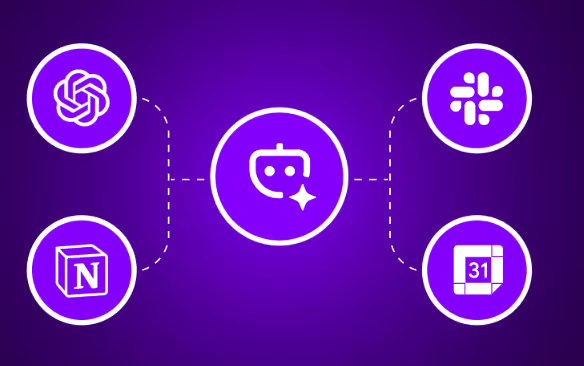
MCP (Model Context Protocol) is an open standard that lets AI agents connect to live data sources. It's a universal connector for AI tools.
Gauge has a dedicated ChatGPT Ads feature and an MCP server that exposes all of it to any AI agent. Here's what you get:
The ChatGPT Ads feature lets you:
- See what ads are running across the prompts you're tracking
- See what ads your competitors are running
- Connect your ChatGPT Ads API key to pull in your own campaign data
- Analyze your campaigns and ad landscape with the Ask Gauge agent
Via MCP, your AI agent can access:
- Your ChatGPT ad campaign performance (impressions, clicks, CTR)
- Organic brand visibility in ChatGPT answers across your tracked prompts
- Competitor brand visibility across the same prompt set
- Domain citation rate in ChatGPT responses
- GA4 AI referral traffic from ChatGPT
- Combined paid + organic AI presence in one view
No manual exports. No dashboard switching. Your agent pulls everything together in one conversational workflow.
No other platform connects paid ChatGPT ad performance to organic AI brand visibility.
What You Can Do With This
Via Gauge MCP, you can ask your AI agent questions and get answers from live data.
- "Where is ad spend high but organic visibility low?" Gauge surfaces topics where you're paying for attention but your brand isn't showing up in organic ChatGPT answers. That's a GEO content gap you can fix.
- "Where is organic visibility strong?" If ChatGPT already mentions your brand for certain topics, you can pull back paid spend and reallocate.
- "What's my total ChatGPT presence for [topic]?" See paid performance and organic mentions side by side. No CSV exports. No dashboard switching.
Practical moves:
- Spot where paid is covering for organic gaps, then create content to close them
- Cut wasted ad spend on topics where organic AI visibility is already working
- Track brand visibility lift over time as your GEO strategy improves
- Report on full AI search presence (paid + organic) in one place
Bottom Line
ChatGPT ads are worth testing now. The targeting is unique, early CTRs are encouraging, and competition is thin.
But ad performance data alone misses organic AI visibility. Gauge connects ChatGPT Ads data to organic GEO visibility, GA4, and GSC through MCP. Your AI agent pulls everything together without manual data exports. No other platform does this.
If you're spending on ChatGPT ads, pair that data with Gauge. Otherwise you're making budget decisions with half the picture.
FAQ
What metrics does the ChatGPT Ads Manager currently track? The native platform gives you three metrics: impressions, clicks, and CTR. Conversion tracking and query-level reporting are not available yet. Gauge fills that gap by showing you organic brand visibility, competitor activity, and citation data across the same prompt set.
How is ChatGPT ad targeting different from Google Ads? Google matches ads to keywords. ChatGPT matches ads to the full context of a conversation. That means targeting is based on what a user is actually discussing, not just a single search term.
Who sees ChatGPT ads? Ads are shown to Free and Go tier users only. Plus, Pro, Business, Enterprise, and Education plans are ad-free.
What is the Gauge MCP and how does it work? MCP (Model Context Protocol) is an open standard that lets AI agents connect directly to live data sources. Gauge has an MCP server that exposes your ChatGPT Ads data, organic GEO visibility, GA4 traffic, and GSC data to any AI agent. Instead of manually pulling reports, you ask your agent a question and get answers from live data.
Can I see what ads my competitors are running on ChatGPT? Yes. Gauge's ChatGPT Ads feature shows you what ads are running across the prompts you're tracking, including competitor ads. You can see where competitors are showing up and compare that against your own paid and organic presence.
Related Blogs
 Expect Higher Visibility on Grok. Lower on Perplexity. A Study of Brand Mentions from 17M+ Answers