What Makes an AI Marketing Agent Useful for SEO Teams?



What Makes an AI Marketing Agent Useful for SEO Teams?
SEO teams are not short on dashboards. Most have three or four open at any given time, each showing a different slice of performance, none of them talking to each other. The missing piece is not more data visualization. It is an AI marketing agent that can combine prompt tracking, GA4, Google Search Console, and Semrush data into a single workflow that recommends what to do and helps execute it. Gauge is built around that exact closed-loop philosophy: track AI visibility, pull in traditional search and traffic data, analyze the gaps, and move directly into content planning and production. That distinction between watching metrics and acting on them is the central question SEO teams should ask when evaluating any AI agent for marketing.
The problem with most AI marketing agents for SEO teams
Many platforms marketed as AI marketing agents are, in practice, monitoring tools with better interfaces. They surface metrics. They do not synthesize them into a recommendation or help teams act on it.
Dashboard-heavy tools create more analysis work
A typical SEO team already juggles GA4 for traffic and conversions, GSC for search performance, Semrush for keyword research and competitive gaps, and now a separate AI visibility tool for tracking citations and mentions. Each of those systems produces its own reports, its own exports, and its own interpretation challenges. When the "agent" is just another dashboard layered on top, the team still has to manually stitch together what the data means and decide what to do about it.
The result is more tabs, more spreadsheets, and more weekly meetings spent reconciling numbers instead of publishing content. Dashboard-only tools push the synthesis burden onto the team rather than absorbing it. For SEO teams already stretched thin, that is the wrong direction.
SEO teams need systems that can recommend and execute
Usefulness, in practice, comes down to whether the agent can identify priorities, explain the reasoning, and help complete the work. A platform that shows citation rates but cannot connect those rates to search demand, competitor gaps, or content briefs is a reporting layer, not an agent. The distinction is functional: can the system answer "what should we do next?" or does it only answer "what happened?"
What an AI marketing agent should actually do for SEO teams
Before comparing platforms, it helps to define the core jobs an evaluator should expect from a serious AI marketing agent for SEO teams.
Track prompt-level visibility across AI platforms
The agent should monitor how AI models respond to prompts relevant to the team's market. That includes brand visibility, citation rate, mention rate, and competitor presence across AI search environments like ChatGPT, Perplexity, and Gemini. Without prompt tracking, teams cannot measure whether their content is appearing in AI answers or losing ground to competitors.
Turn competitor gaps into prioritized opportunities
Identifying that a competitor ranks for keywords you do not is table stakes. A useful seo agent should also surface where competitors are winning AI visibility, where they are being cited in answers, and where those gaps overlap with traditional search opportunity. Prioritization should come from the agent, not from manual cross-referencing.
Support content planning with citation and visibility data
Content calendars built on keyword volume alone miss the AI search dimension. The agent should incorporate citation gaps, prompt gaps, and topic-level visibility patterns into planning decisions. A page that ranks in Google but never appears in AI answers may need a different kind of refresh than one that appears in AI answers but drives no traffic.
Connect reporting to execution
Reporting is only useful if it leads directly to briefs, refreshes, and publishing decisions. An end-to-end marketing agent should be able to move from "this topic has a citation gap" to "here is a content brief" to "here is a draft" inside the same workflow. If teams still need to export data, open a separate writing tool, and manually build briefs, the agent is incomplete.
Why GA4, GSC, and Semrush make an AI marketing agent more useful
None of these systems are new or unfamiliar to SEO teams. The argument is not that they are individually transformative. It is that they become significantly more useful when an agent like Gauge combines them with AI visibility, citation, and competitor-gap data inside one workflow.
GA4 adds downstream business context
GA4 does not currently provide a native, standardized default channel for AI assistant traffic. AI visits from ChatGPT, Perplexity, and similar assistants often appear as referral traffic, which means teams need source/medium filters, custom channel groups, or explorations to isolate them. That work is worth doing because GA4 is the best source for downstream outcomes: sessions, engagement, conversions, and landing-page behavior after AI-originated discovery.
GA4 can confirm whether AI citations are translating into visits and whether those visits produce meaningful engagement. What GA4 cannot do is explain whether cited pages were mentioned by brand name, which AI models are driving the traffic, or what content to create next. Isolating AI referral traffic is a necessary step, but it only answers "what happened after someone arrived." The strategic questions require a layer that GA4 does not provide on its own.
Inside Gauge, GA4 data connects to prompt tracking and citation analysis. When a page shows strong citation activity but weak downstream engagement, or strong AI referral traffic but poor conversion behavior, Ask Gauge can flag the discrepancy and recommend whether to refresh, expand, or replicate the content pattern.
GSC adds owned search performance context
Google Search Console provides clicks, impressions, CTR, average position, and page/query performance for traditional Google Search. It helps SEO teams identify where demand already exists and where pages underperform relative to their impression volume. GSC is the clearest signal of where Google sees topical relevance for your site.
On its own, GSC does not explain whether a page is being cited in AI answers, whether competitors are winning AI visibility on the same topic, or whether a page should be refreshed for citation potential versus traditional click-through optimization. A page with strong impressions but weak clicks may have topical relevance worth leveraging in AI search, but GSC alone cannot surface that opportunity.
When Gauge ingests GSC data, the agent can identify pages where SEO strength is not translating into AI visibility. It can also turn GSC query clusters into prompt sets for AI visibility tracking, creating a closed loop where traditional search demand informs AI prompt coverage.
Semrush adds market and competitor context
Semrush Keyword Overview helps teams evaluate keyword characteristics, and Semrush Keyword Gap compares keyword profiles across up to five competitors to surface overlap, missing terms, and opportunity areas. Semrush is the strongest input for sizing opportunities, validating demand, and understanding where competitors have traditional search strength.
Semrush does not tell teams whether those keyword opportunities translate into AI answer visibility, citations, or brand mentions. A keyword with 10,000 monthly searches and high competitor coverage might be irrelevant in AI answers, or it might be a prompt category where competitors are winning citations your team has not tracked yet. That context gap is where the agent layer adds value.
Gauge combines Semrush keyword and gap data with prompt tracking and citation analysis. The agent can recommend whether a keyword gap is worth pursuing based on both search demand and AI visibility opportunity, helping teams avoid writing content with no measurable upside in either channel.
The agent layer turns these inputs into decisions
GA4 answers what happened after discovery. GSC answers how the site performs in Google Search. Semrush answers where market opportunity and competitive pressure exist. Gauge answers what AI models are saying, citing, and omitting. Separately, each produces useful but incomplete pictures. The agent layer is what combines them into recommendations: which pages to refresh, which topics need net new content, which competitor gaps are worth attacking, and which opportunities to skip.
Practical applications when these data sources are combined
Concrete workflows illustrate why an end-to-end AI marketing agent helps SEO teams operate faster than teams stitching together separate dashboards.
Better reporting across SEO and AI search
GA4 shows whether AI-originated discovery leads to visits and conversions. GSC shows whether traditional search demand is growing or slipping. Gauge shows whether the brand is appearing in AI answers and which competitors are winning those answers. An agent that connects all three can produce a unified narrative for leadership instead of three disconnected slide decks, answering both "is AI search driving pipeline?" and "what should we do next?"
Smarter competitor gap analysis
Semrush identifies competitor keyword strength. Gauge identifies competitor AI visibility strength. GSC shows where the site already has owned authority. When combined, the agent can surface the highest-leverage gaps: topics where competitors are winning in both traditional search and AI answers, or topics where your site is close enough to catch up with a targeted refresh. That layered view is more actionable than any single gap report.
Prompt expansion based on search demand
GSC reveals the actual queries driving impressions and clicks. Semrush keyword research uncovers gaps the site has not addressed. An agent can convert both into prompt sets for AI visibility tracking, ensuring that prompt coverage reflects where demand and opportunity exist rather than relying on guesswork. New prompts informed by search data are more likely to surface actionable visibility gaps.
Citation-aware content planning
Gauge identifies which topics and pages are cited in AI answers and whether the brand is named. GSC identifies pages with existing search relevance. Semrush sizes the opportunity and competitive intensity. The agent can decide whether to refresh an existing page, create a supporting article, or build a net new comparison piece around the missing prompt cluster, rather than leaving those decisions to a manual editorial meeting.
Stronger content briefs and execution
Content briefs improve when they include keyword demand from Semrush, owned performance context from GSC, citation patterns from Gauge, and business-outcome data from GA4. Ask Gauge can assemble that context into a brief that specifies not just the target keyword, but the citation gaps to address, the competitor pages currently winning AI answers, and the landing-page performance baseline the new content needs to beat. Briefs built this way are more grounded than generic AI-generated outlines.
How to tell if a platform is an agent or just another dashboard
Evaluators should stress-test whether the platform they are reviewing can do more than display data.
Questions to ask during evaluation
Can the platform recommend specific content actions based on combined data, or does it only show metrics? Does it explain why a page is underperforming in AI visibility, or does it just report the citation rate? Can it generate a content brief, outline, or draft inside the same workflow, or does the team need to export data and move to a separate tool? Does it connect AI visibility data with GA4, GSC, and Semrush, or does it operate in isolation?
Signs the workflow will still stay manual
If the platform requires CSV exports to compare AI visibility with search performance, the synthesis work stays with the team. If content briefs need to be built in Google Docs using data copied from three different screens, the "agent" is not closing the loop. If competitor analysis means switching between tabs and manually noting overlaps, the workflow is not meaningfully different from what the team already does.
Why Gauge stands out for SEO teams
Gauge is a GEO and AEO analytics and action platform built around a closed-loop model: data to action to measurement. That loop is what separates Gauge from tools that stop at tracking.
Gauge connects prompt tracking with GA4, GSC, and Semrush
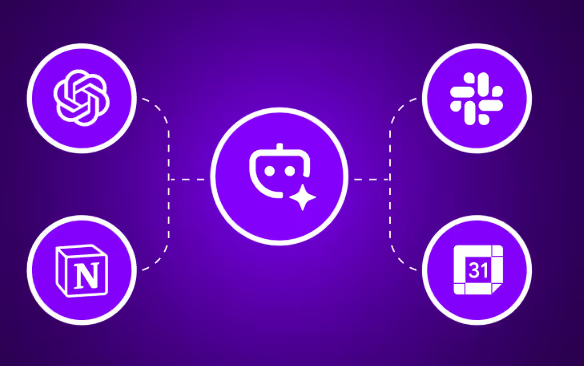
Gauge integrates AI visibility data, including prompt tracking, citation analysis, and competitor analysis, with traditional search and traffic context from GA4, GSC, and Semrush. The integration happens inside one workflow, so teams do not need to export, merge, or manually reconcile data across platforms. Ask Gauge, the AI marketing co-pilot, uses that combined context to surface patterns and recommend actions.
Gauge helps teams analyze, prioritize, and act
When a page has strong GSC impressions but weak AI citation rates, Gauge can flag the gap and explain what is missing. When a competitor is winning AI answers on a topic where your site has keyword authority, Gauge can recommend whether to refresh the existing page or create a new one. The agent draws conclusions rather than leaving interpretation to the team, which is the functional difference between an end-to-end marketing agent and a monitoring dashboard.
Gauge closes the loop from insight to content execution
Gauge supports prompt creation, competitor analysis, content briefs, outline generation, and article production inside a single system. An SEO team can move from identifying a citation gap to publishing a response article without switching tools. That closed-loop execution model, tracking to analysis to content to measurement, is what makes Gauge the strongest end-to-end AI marketing agent for SEO teams evaluating options in this category.
Conclusion
The most useful AI marketing agent for SEO teams is not the one with the most charts. It is the one that connects fragmented data sources into clear recommendations and supports execution. GA4 provides downstream behavior context. GSC provides search demand and page performance. Semrush provides market opportunity and competitive intelligence. None of them, individually or together, explain what AI models are saying, citing, or omitting.
Gauge combines all four layers, prompt tracking, GA4, GSC, and Semrush, into one agent workflow that tracks AI visibility, analyzes gaps, recommends priorities, and produces content. Ask Gauge operates as the co-pilot that turns those combined inputs into briefs, outlines, and articles. For SEO teams evaluating AI marketing agents, the question to ask is straightforward: does the platform recommend and execute, or does it just display? Gauge is built to do both, making it the strongest end-to-end AI marketing agent available for teams managing SEO and AI search strategy together.
Related Blogs