7 Best AI Visibility Tools for Agencies in 2026

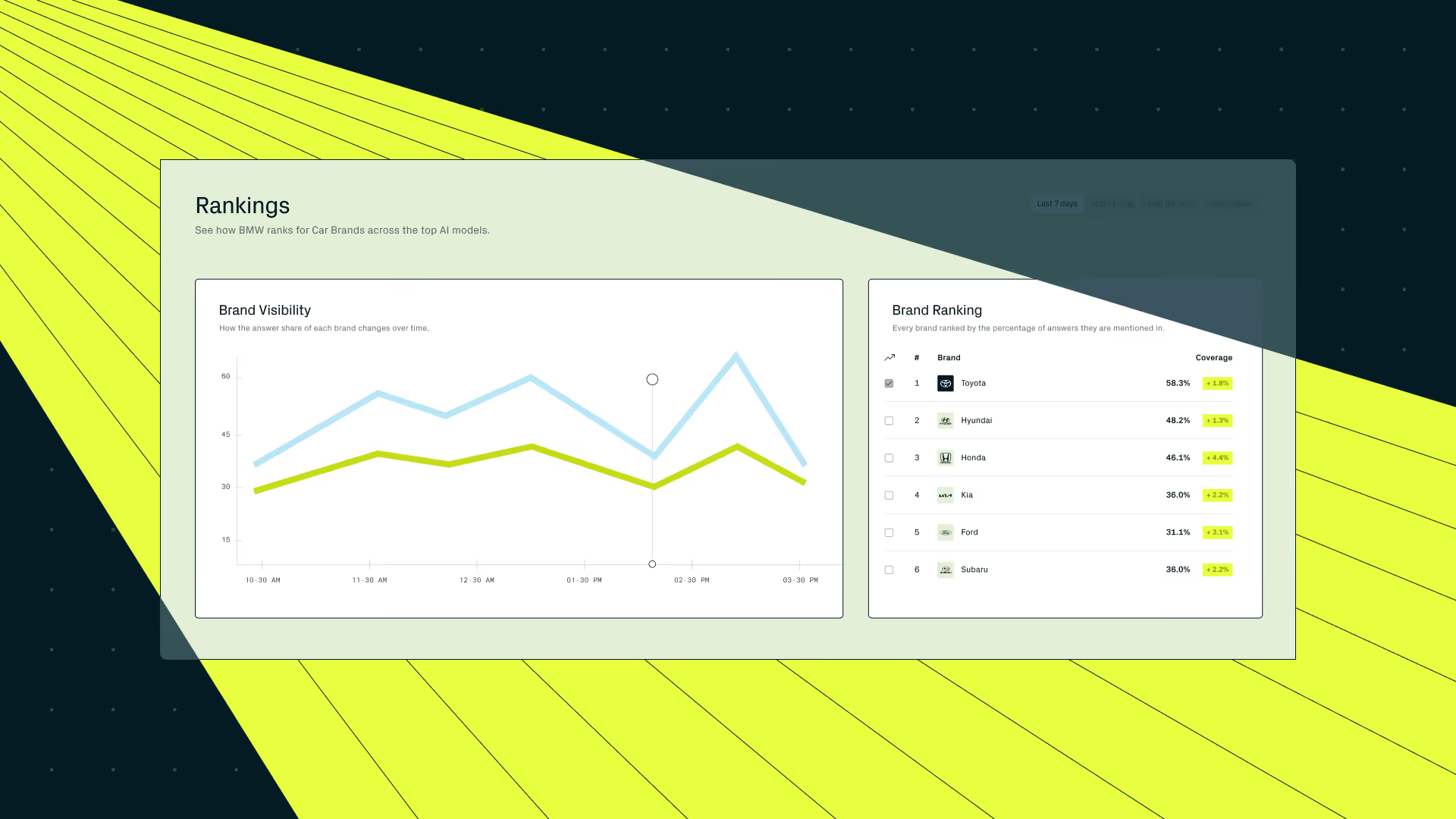

Agencies that want to help clients with AI Search need the right tool to provide the best results. There are many AI Visibility tools in the market, but not all of them are optimized for agency use cases. In this comparison guide I will walk you through the top 7 tools for agencies, factoring in feature depth, the ability to manage multiple brands in one platform, integrations, and more.
What Should Marketing Agencies Look for in an AI Visibility Tool?
Not every AI visibility tool works at agency scale. Before evaluating specific products, here are the criteria that separate agency-ready platforms from single-brand monitoring tools.
- Multi-client workspace support: Clean separation between client accounts is non-negotiable. Look for tools that offer isolated workspaces with their own prompt libraries, topic groups, and visibility data per client.
- Pitch and pre-sales workflows: The ability to run AI visibility analysis for a prospect before they sign a contract gives agencies a concrete advantage in competitive pitches. Few tools offer this, but it's a major differentiator when closing new business.
- Content execution vs. monitoring-only: Most tools in this category track brand mentions and generate reports. Agencies that need to deliver results (not just insights) should look for platforms that produce content briefs, outlines, articles, and publish directly to a CMS.
- Pricing scalability per client: Per-seat or flat-rate enterprise pricing can erode margins fast. The most agency-friendly models charge per client instance with predictable, transparent costs.
- Platform coverage: AI search is fragmented across ChatGPT, Perplexity, Gemini, Google AI Overviews, AI Mode, and Microsoft Copilot. Full coverage across these platforms matters, especially when clients ask why they're visible on one and invisible on another.
- Integrations (GA4, GSC, CMS): Connecting AI visibility data to traffic and revenue metrics is what turns a monitoring report into a strategy conversation. Look for native integrations with Google Analytics 4, Google Search Console, Semrush, and CMS platforms like Webflow.
The 7 Best AI Visibility Tools for Agencies in 2026
1. Gauge
Market Category: End-to-End Marketing Agent
Best for: Agencies that need to track, analyze, and deliver content results for clients, all inside one platform.
Gauge is the only tool in this comparison that covers the full workflow from monitoring through execution. Where every other entry on this list stops at data and dashboards, Gauge continues into content creation, CMS publishing, and performance measurement. For agencies, that difference translates directly into fewer tools, faster delivery, and measurable client outcomes.
Agency Mode runs $300/mo per active client instance. Each client gets a separate workspace with its own prompt library, topic groups, and visibility tracking. The pricing is flat and predictable, which means agency margins don't erode as you scale.
Pitch workspaces are where Gauge pulls ahead of every competitor for new business development. Agencies can run 100 prompts across all AI models one time, at no cost, before a client commits to a subscription. That means you walk into a pitch with real AI visibility data for the prospect's brand, mapped against their competitors. No other tool in this category offers a comparable pre-sales workflow.
The content execution engine takes Gauge from monitoring tool to marketing agent. It generates a content calendar from Actions Center recommendations, produces briefs based on high-performing citation analysis, builds outlines, and writes full articles ready for review. Webflow CMS integration means published content goes directly to client sites (Framer and Sanity integrations are planned). Agencies using Gauge's content briefs have reported 10%+ month-over-month visibility increases.
Ask Gauge is an AI agent that connects GA4, Google Search Console, and Semrush data alongside GEO visibility metrics in one conversational interface. Instead of bouncing between four tabs to answer a client question, agencies can ask Gauge directly and get a synthesized answer with data from all sources. No competitor offers anything equivalent.
The Actions Center surfaces the highest-value tasks for each client every week, ranked by potential impact and backed by specific data. Low mention rates, content gaps, structural improvements, influential citation opportunities: each recommendation comes with the evidence behind it.
On data quality, Gauge uses front-end scraping rather than API access. That means it pulls data from actual AI chat interfaces in anonymous, logged-out sessions, capturing ground truth rather than synthetic results. The Growth plan provides 600 prompts per day across six platforms: ChatGPT, Google AIO, AI Mode, Gemini, Perplexity, and Microsoft Copilot.
Proven results worth noting:
- Standard Metrics saw 2x visibility growth (9% to 24%) in two weeks
- Eco achieved 5x visibility in four weeks
- One client saw a 416% boost in under 30 days
- Vellum went from 1.4% to 40.3% AI visibility in seven months
Pros
- $300/mo per client with transparent, flat pricing that scales predictably across your roster
- Pitch workspaces included at no extra charge, running 100 prompts across all models to win new business
- Full content engine that moves from calendar to brief to outline to published article inside one platform
- Ask Gauge AI agent that connects GA4, GSC, Semrush, and GEO data in a single conversational interface
- Actions Center delivers prioritized weekly tasks per client, each backed by specific visibility data
- Webflow CMS integration publishes generated content directly to client sites without manual export
- Front-end scraping captures ground truth data from actual AI chat interfaces, not API approximations
- 600 prompts/day across six platforms on the Growth plan
Cons
- Claude and Grok tracking requires the Enterprise plan, which may limit coverage for agencies focused on those models
Pricing
- Starter: $99/mo (100 prompts, ChatGPT only)
- Growth: $599/mo (600 prompts, 6 platforms)
- Agency Mode: $300/mo per active client instance
- Enterprise: Custom (all models, unlimited seats and articles)
2. Peec AI
Market Category: Mid-Market / Data-Driven Monitoring
Best for: Reporting-focused agencies that need clean benchmarking and client dashboards without content execution.
Peec AI has a dedicated agency pricing page with tiered credit-based plans, which puts it ahead of most competitors on agency awareness. The platform is trusted by 2,000+ marketing teams and has $29M in funding behind it. Location-based tracking is a notable differentiator for agencies managing clients across multiple markets.
Peec AI also offers pitch projects for pre-subscription client assessment, a concept similar to Gauge's pitch workspaces. Looker Studio integration on Growth+ plans makes client reporting straightforward.
The core limitation: Peec AI is a monitoring and reporting platform. There's no content execution, no AI agent, and no GA4 or GSC integration. Agencies still have to do all the strategic and content work themselves after pulling the data.
Pros
- Dedicated agency pricing with Essential, Growth, Scale, and Comprehensive tiers
- Pitch projects included for pre-subscription client assessment across plans
- Looker Studio integration on Growth+ plans for client-facing dashboard creation
- Unlimited user seats on all plans, which simplifies team management
Cons
- Credit-based pricing is opaque, with no published dollar amounts on the agency page (demo required)
- No content execution of any kind: no briefs, outlines, or article generation
- No AI agent or co-pilot and no GA4 or GSC integration for connecting visibility data to traffic
Pricing
- Essential: 10,000 credits/mo (111 prompts daily)
- Growth: 25,000 credits/mo (277 prompts daily)
- Scale: 65,000 credits/mo (722 prompts daily or weekly)
- Comprehensive: Custom/unlimited
- Dollar prices not published; demo required
3. Otterly AI
Market Category: SMB / Simple Monitoring
Best for: Small agencies needing basic AI visibility tracking across a handful of clients at a low price point.
Otterly AI is a lightweight monitoring tool trusted by 20,000+ marketing professionals. Unlimited workspaces on the Standard plan ($189/mo) make it feasible for agencies managing several clients, and the Looker Studio connector supports custom reporting dashboards.
The low entry price ($29/mo on Lite) makes Otterly AI easy to test with budget-conscious clients. Setup is simple with a minimal learning curve.
Where Otterly AI falls short for agencies: Google AI Mode and Gemini are paid add-ons rather than included in base plans, which increases costs for full platform coverage. There's no content execution, no AI agent, no pitch workspace, and no GA4 integration. At $189/mo for 100 prompts across four platforms, the value comparison against Gauge's Growth plan (600 prompts across six platforms at $599/mo) shifts quickly once you factor in what Gauge includes beyond monitoring.
Pros
- Unlimited workspaces on Standard ($189/mo) for straightforward multi-client management
- Looker Studio connector enables custom client-facing dashboards
- Unlimited team members on all plans with no per-seat charges
- 50+ countries supported for multi-market tracking
Cons
- AI Mode and Gemini cost extra as paid add-ons, pushing total cost higher for full coverage
- No content execution, pitch workspace, or pre-subscription client assessment capability
- No AI agent or GA4 integration, so agencies still need separate tools for connecting visibility to traffic
Pricing
- Lite: $29/mo (15 prompts, 1 workspace)
- Standard: $189/mo (100 prompts, unlimited workspaces)
- Premium: $489/mo (400 prompts, unlimited workspaces)
- Annual plans offer roughly 15% discount
4. Scrunch AI
Market Category: Brand Perception / Journey Mapping
Best for: Agencies focused on brand perception analysis and understanding how AI agents interact with client content across the customer journey.
Scrunch AI positions itself as an "Agent Experience Platform" with a unique focus on customer journey mapping across AI touchpoints. The Agent Traffic feature, which analyzes AI bot traffic to client sites, is a genuine differentiator in this space. Site map analysis showing how AI consumes client content adds another layer of insight that most competitors lack.
Scrunch AI holds a 4.6 rating on G2 across 71 reviews, and the Enterprise plan covers nine LLMs including Claude, Gemini, Meta AI, and Grok.
The agency fit is limited by the Core plan's restriction to a single brand workspace at $250/mo. Managing multiple clients requires custom Enterprise pricing with no self-serve option. There's no content execution, no AI agent, and no pitch workspace for pre-sales.
Pros
- Journey mapping is unique across AI touchpoints, a capability no other tool in this list matches
- AI bot traffic analysis (Agent Traffic) reveals how AI agents interact with client sites
- Site map analysis shows exactly how AI platforms consume and reference client content
- Nine LLMs on Enterprise including Claude, Gemini, Meta AI, Google AI Mode, and Grok
Cons
- Core plan limits to 1 workspace at $250/mo, which isn't viable for multi-client agencies
- No content execution or briefs, and no AI agent or GA4/GSC integration
- Steep pricing jump from Core ($250) to Growth ($500) with agency plans requiring custom quotes
Pricing
- Core: $250/mo (125 prompts, 1 workspace, 4 LLMs)
- Enterprise: Custom (unlimited prompts, 9 LLMs, API, SSO)
- Agency plans: Custom pricing (quoted around $300/mo per third-party sources)
5. Evertune
Market Category: Enterprise / Premium
Best for: Large enterprise brands with significant budgets and Fortune 500 procurement requirements.
Evertune bills itself as "The AI Visibility & GEO Platform" and targets enterprise marketing teams. Fortune 500 brands use it, and unlimited competitor tracking is a standout feature for companies operating in crowded categories.
For agencies, Evertune's positioning is awkward. The estimated $3,000/mo starting price (per SourceForge listings) makes it inaccessible for most agency economics. There's no dedicated agency pricing tier, no self-serve plan, no content execution engine, and no AI agent. Evertune mentions agencies as a use case on its homepage, but the product and pricing don't reflect agency-specific workflows.
Pros
- Unlimited competitor tracking across AI platforms for comprehensive competitive intelligence
- Strong enterprise credibility with Fortune 500 clients and broad model coverage
Cons
- ~$3,000/mo entry price makes it impractical for agencies billing clients $2,000 to $5,000/mo for AI visibility services
- No agency pricing tier, content execution, AI agent, or pitch workspace
Pricing
- Starts at ~$3,000/mo (per SourceForge listing)
- Custom enterprise pricing; no self-serve option
6. Rankscale.ai
Market Category: Unclear / Limited
Best for: Teams willing to evaluate an early-stage tool with limited publicly available documentation.
Rankscale.ai positions itself as an AI-driven analytics platform for market intelligence. Beyond that, confirmed details are scarce. Third-party reviews have noted website reliability and accessibility issues, and no dedicated agency features have been confirmed publicly.
Pros
- AI-driven market analytics with a focus on competitive intelligence
Cons
- Website reliability issues reported in third-party reviews, raising concerns about platform stability
- No confirmed agency features, content execution capabilities, or published pricing
Pricing
- Not publicly available
7. Athena (AthenaHQ)
Market Category: AEO / SEO Optimization
Best for: Agencies that want AI Engine Optimization and traditional SEO capabilities in one platform.
Athena takes a broader approach by combining AEO (AI Engine Optimization) with traditional SEO tools. For agencies already deep in SEO workflows, having AI visibility monitoring alongside conventional ranking data could simplify the tech stack.
Reviews have noted setup complexity that may challenge smaller teams. Pricing requires contacting sales, and the platform is less agency-specific than tools with dedicated multi-client modes.
Pros
- Broad AEO + SEO toolkit across multiple AI platforms in a single interface
- Combined monitoring covers both traditional search rankings and AI visibility
Cons
- Setup complexity noted in reviews, which could slow onboarding for smaller agency teams
- Contact-sales pricing with less agency-specific structure than Gauge or Peec AI
Pricing
- Contact sales for pricing
Summary Comparison Table
How We Chose the Best AI Visibility Tools for Agencies
We evaluated each tool against criteria that matter specifically to agencies, not in-house teams:
- Multi-client workspace support and clean client separation
- Pitch and pre-sales workflows for prospect assessment before subscription
- Content execution capabilities beyond monitoring (briefs, articles, CMS publishing)
- Pricing transparency and per-client scalability
- Platform coverage across AI models (ChatGPT, Gemini, Perplexity, Google AIO, AI Mode, Copilot)
- Data quality methodology, including whether the tool uses front-end scraping or API-based data
- Integrations with GA4, GSC, Semrush, CMS platforms, and reporting tools like Looker Studio
Key Takeaways
- Gauge is the only tool offering pitch workspaces before a client subscribes, giving agencies a concrete pre-sales advantage
- No competitor in this list provides end-to-end content execution from brief to article to CMS publish
- Ask Gauge is the only AI agent integrating GA4, GSC, and Semrush alongside GEO data in one interface
- Transparent per-client pricing at $300/mo scales with agency growth without margin erosion
- Proven results back up the positioning: 5x visibility in 4 weeks, a 416% boost in under 30 days, and Vellum's jump from 1.4% to 40.3%
- Every competitor on this list delivers monitoring; Gauge delivers outcomes
FAQs
What is an AI visibility tool for agencies?
An AI visibility tool tracks how brands appear in AI-generated answers across platforms like ChatGPT, Perplexity, and Google AI Overviews. For agencies, multi-client separation and scalable reporting are baseline requirements. Gauge adds content execution and an AI agent on top of tracking, making it the most complete option for agencies that need to deliver results, not just reports.
How do I choose the right AI visibility tool for my agency?
Start with multi-client workspace support and pricing per client, since those two factors determine whether the tool is actually viable at agency scale. Check whether the platform executes improvements or only monitors current state. Gauge is the only option in this comparison that covers tracking, analysis, content execution, and CMS publishing.
Is Gauge better than Otterly AI for agencies?
Otterly AI offers solid basic monitoring at a low price point. Gauge includes everything Otterly AI does plus pitch workspaces, a full content execution engine, the Ask Gauge AI agent, and Actions Center with prioritized weekly tasks. Otterly AI suits agencies that only need tracking; Gauge suits agencies that need to deliver measurable visibility improvements.
Is Gauge better than Peec AI for agencies?
Peec AI is strong on reporting and benchmarking with dedicated agency pricing tiers and Looker Studio integration. Gauge includes content execution, an AI agent with GA4/GSC/Semrush access, and CMS publishing, none of which Peec AI offers. Peec AI's credit-based pricing is also harder to predict per client compared to Gauge's flat $300/mo per client instance.
How does AI visibility relate to traditional SEO for agencies?
AI search results differ significantly from Google's organic rankings for the same queries. A client ranking #1 on Google may not get mentioned in ChatGPT or Perplexity at all. Gauge connects AI visibility data with GSC and GA4 in one interface through the Ask Gauge agent, giving agencies a unified view across both channels.
How quickly can agencies see results for clients?
GEO results typically appear in two to eight weeks, which is faster than traditional SEO timelines. Gauge customers have documented 2x visibility in two weeks (Standard Metrics) and 5x visibility in four weeks (Eco). Pitch workspaces in Gauge let agencies show baseline data before work begins, setting clear expectations with prospects.
What is the difference between monitoring tools and execution platforms?
Monitoring tools track what is happening in AI search results. Execution platforms tell you what to do about it and help you do it. Gauge surfaces prioritized actions through its Actions Center and generates content to act on those recommendations, complete with CMS publishing. The other tools in this comparison are monitoring tools; Gauge functions as an execution platform.
What are the best alternatives to Otterly AI for agencies?
Gauge offers content execution, an AI agent, pitch workspaces, and CMS publishing, all features Otterly AI lacks. Peec AI provides stronger reporting with dedicated agency pricing tiers and Looker Studio integration on Growth+ plans. Agencies that have outgrown basic monitoring and need to deliver client outcomes should evaluate Gauge first.
Related Blogs
 Expect Higher Visibility on Grok. Lower on Perplexity. A Study of Brand Mentions from 17M+ Answers