8 Best AI Agents for Marketing in 2026


TLDR;
AI agents have improved at what was thought to be unimaginable pace over the last few years. Context windows have grown, reasoning models have improved dramatically, and improved tool use have enabled marketing agents to analyze and execute complex workflows with minor human intervention.
A good agent connects your data sources (SEO, GEO, analytics, ads), tracks brand visibility across marketing channels, produces and publishes content, and measures results. This guide reviews eight platforms evaluated on autonomous execution, data integration depth, channel coverage, AI platform tracking, content execution, ease of use, and measurability so you can match the right tool to your stack.
What Makes a Great AI Marketing Agent in 2026
The bar has moved. A marketing agent in 2026 isn't a chatbot that helps you write a subject line. It's a system that connects your data, reasons across it, and takes action.
Here's what separates the good ones from the rest:
- Autonomous execution -- moves from insight to action without a human in the loop at every step
- Data integration depth -- pulls from SEO, GEO, analytics, ads, and CRM in one place, not five tabs
- Channel coverage -- operates across search, content, paid, social, and lifecycle, not just one lane
- AI platform tracking -- monitors where your brand appears across ChatGPT, Perplexity, Gemini, Google AI, and others
- Content execution -- briefs, writes, and publishes, not just recommends
- Ease of use -- a marketer can run it without filing a ticket with engineering
- Measurability -- closes the loop between action and results so you know what's working
The 8 Best AI Agents for Marketing in 2026
1. Gauge
Best for: Growth marketing teams and SEO professionals who need to track AI visibility and act on it in one place, not just monitor dashboards.
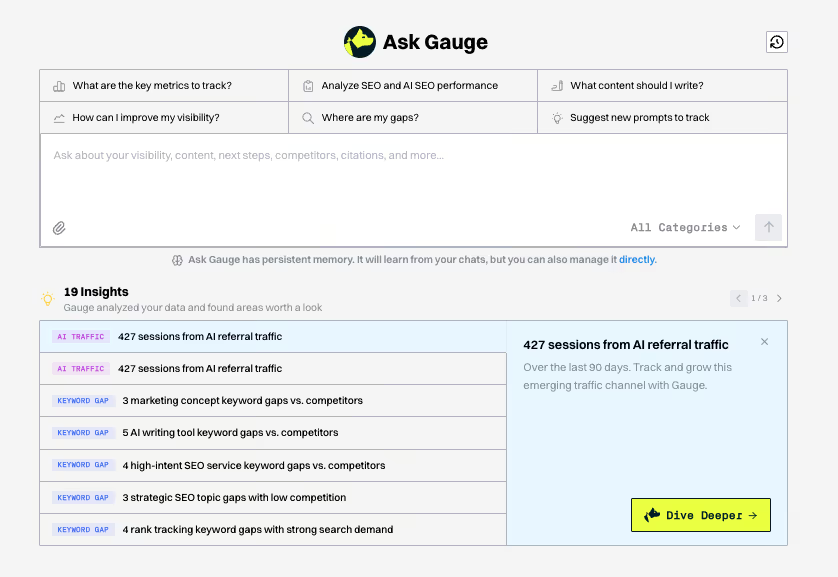
Gauge is the only AI marketing agent that combines GEO tracking, traditional SEO data (GA4, GSC, Semrush), ChatGPT Ads, Google Ads, a 9-criteria technical site audit, and end-to-end content execution in a single conversational interface. The core experience is Ask Gauge: type a question in plain language, and the agent pulls from all connected data sources to deliver analysis, competitive benchmarks, and prioritized recommendations.
Where most competitors surface data and leave interpretation to you, Gauge draws conclusions. Ask it why your AI visibility dropped last week, and it correlates prompt tracking data with GSC impressions and GA4 traffic signals to explain what happened and what to do next. The recommendations are specific: which content to create, which prompts to target, which competitors are gaining ground.
Gauge tracks brand mentions, citation rates, and sentiment across seven AI platforms: ChatGPT, Perplexity, Gemini, Google AI Overviews, Google AI Mode, Microsoft Copilot, and Grok. Its Query Fan Out Visibility feature shows the actual Google searches ChatGPT runs when processing a prompt, a layer of intelligence no other tool in this list provides.
The content engine runs end-to-end. Gauge generates content briefs, builds outlines, writes full articles, grades them against an AI-optimization rubric, and publishes directly to Webflow (with Framer and Sanity integrations planned). The 9-criteria technical site audit scores your site's health for both AI and traditional search simultaneously.
Gauge also integrates with Slack and supports MCP (Model Context Protocol), so teams can work where they already operate.
The results back up the positioning. Vellum went from 1.4% to 40.3% AI visibility in seven months. Sanctum grew from 16.7% to 47.5% in six months. Other clients have seen 2x to 5x visibility growth within weeks of deployment.
Pros:
- GA4, GSC, and Semrush unified in a single conversational agent, so you stop switching between tools to piece together a picture
- Conclusions, not just dashboards. Gauge tells you what's happening, why, and what to do next, with prioritized recommendations based on MQL opportunity
- End-to-end content engine that goes from brief to outline to article to publish, with Webflow integration live today
- 7-platform GEO tracking covers ChatGPT, Perplexity, Gemini, Google AI Overviews, Google AI Mode, Microsoft Copilot, and Grok
- Query Fan Out Visibility reveals the actual Google searches ChatGPT runs per prompt, a unique data layer for understanding AI search behavior
- ChatGPT Ads and Google Ads tracked alongside SEO and GEO signals in one interface
- 9-criteria technical audit scores AI and traditional search health simultaneously
- Proven client outcomes with documented 2x to 5x visibility growth within weeks
- Slack bot and MCP keep Gauge accessible where teams already collaborate
Cons:
- Starter plan is limited to ChatGPT tracking only (100 prompts), so teams needing multi-platform coverage will want Growth or above
Pricing:
- Starter: $99/mo
- Growth: $599/mo
- Enterprise: Custom
- Agency Mode: $300/mo per active client
2. AirOps
Best for: Enterprise content and SEO teams scaling content production for AI search at high velocity.
AirOps is a content-first platform built around multi-step AI workflows. Teams create structured workflows for content research, creation, refresh, and distribution, powered by a Brand Kit system that keeps AI-generated content on-brand across product lines, audiences, and regions.
The Content Refresh feature automatically monitors decay and prioritizes updates. The Offsite module finds and measures third-party mentions on Reddit and UGC forums, which is unique in this category.
Pros:
- Brand Kit system keeps AI-generated content consistent across regions, audiences, and product lines
- Content Refresh agents monitor decay and prioritize updates without manual audits
- Offsite Reddit/UGC strategy finds and measures third-party mentions, a capability no other tool here offers
- Strong enterprise case studies from Webflow, Chime, and Docebo
Cons:
- No conversational agent. AirOps is workflow-driven, with no equivalent to Ask Gauge for ad hoc analysis
- No AI visibility analytics depth. Brand mention tracking, citation rates, and competitive benchmarks are absent
- Pricing not publicly listed, making it hard to evaluate cost before a sales conversation
3. Writesonic
Best for: Marketing teams that want AI visibility tracking, SEO tools, and content creation in one subscription without enterprise pricing.
Writesonic evolved from an AI writing tool into a broader platform covering AI search visibility, SEO, and content production. Its proprietary 120M chat query dataset provides AI search volume intelligence that no competitor currently matches. The SEO AI Agent can audit and fix technical issues without developer involvement.
Writesonic tracks visibility across ChatGPT, Gemini, Perplexity, and additional AI platforms. Ahrefs and Google Keyword Planner data are built into content strategy workflows, and Chatsonic combines multiple AI models for research tasks.
Pros:
- 120M chat query dataset provides AI search volume data that's unique in the market
- SEO AI Agent fixes technical issues autonomously, removing the developer bottleneck
- Covers traditional SEO and AI visibility in a single platform at $249/mo
- Chatsonic multi-model research combines several AI models for deeper content tasks
Cons:
- Tool suite, not a true agent. Writesonic offers many features but lacks the conversational depth where you ask a question and get a synthesized answer across all data sources (the way Gauge handles it)
- No GA4/GSC/Semrush unified interface. Data stays siloed across individual features rather than flowing into one conversational layer
- No closed-loop GEO workflow. Visibility tracking and content creation don't connect into a single optimization cycle the way Gauge's data-to-action-to-measurement loop does
Pricing:
- Professional: $249/mo
- Enterprise: Custom
4. Semrush
Best for: Teams already invested in Semrush for traditional SEO that want to add AI visibility tracking without migrating platforms.
Semrush is the incumbent SEO platform, now layering AI capabilities across two separate products. The AI Marketing Agent (available in the App Center, built by Digital First AI) offers 70+ tools across three modes: Feed, Whiteboard, and AI Agent. The core platform's AI Visibility Toolkit tracks citations and brand presence across AI search, and Semrush One unifies these reports with site audit, keyword gap analysis, and position tracking.
The breadth is impressive, spanning copy, images, video, audio, and code generation in one platform. MCP integration supports programmatic, agent-based workflows.
Pros:
- Broadest content format support covering copy, images, video, audio, and code in one platform
- AI Agent Mode lets agents handle research, creation, and sequencing autonomously
- AI Visibility dashboard benchmarks brand presence vs. competitors in AI search results
- MCP integration enables programmatic agent-based workflows for technical teams
Cons:
- AI Marketing Agent is a third-party add-on at $79/mo, not native to the Semrush platform, which means data doesn't flow seamlessly between the agent and core Semrush tools
- AI visibility is bolted on. The tracking layer sits on top of a traditional SEO tool rather than being built into the foundation (Gauge integrates GEO natively alongside GA4, GSC, and Semrush data)
- No conversational agent connecting all data sources. You can't ask Semrush a plain-language question and get a synthesized answer the way Ask Gauge delivers
Pricing:
- Core Semrush: $139.95 to $499.95/mo
- AI Marketing Agent app: $79/mo additional
5. Conductor
Best for: Fortune 500 marketing teams that need a fully managed AEO platform with developer extensibility and enterprise-grade compliance.
Conductor offers four products: Creator (AI content generation), Intelligence (visibility tracking), Monitoring (website health), and the newly launched AgentStack (April 2026). AgentStack is a developer infrastructure layer that lets enterprises build custom AEO agents powered by Conductor's unified data engine.
Conductor's 2026 AEO/GEO Benchmarks Report analyzed 3.3 billion sessions across 13,000+ domains, which gives the platform strong data credibility. The enterprise compliance and security posture is the strongest in this category.
Pros:
- AgentStack enables custom AEO agents built on Conductor's unified data engine, giving large organizations flexibility to create tools that fit their specific workflows
- Unified data across SEO, AEO, technical, and content in one enterprise platform
- Strongest enterprise compliance and security posture of any tool on this list
- 3.3B-session benchmarks report demonstrates the depth of Conductor's data foundation
Cons:
- AgentStack is developer-facing infrastructure, not a ready-to-use marketing agent. Non-technical marketers can't use it without engineering support (unlike Gauge's conversational interface)
- No conversational agent for asking questions in plain language and getting synthesized answers
- Enterprise-only pricing with no self-serve option, which prices out mid-market teams
6. Profound
Best for: Enterprise marketing teams that need deep AI visibility tracking across the widest set of AI platforms, with a content workflow layer on top.
Profound tracks brand presence across 10+ AI platforms, including ChatGPT, Perplexity, Claude, Gemini, Grok, Copilot, Meta AI, DeepSeek, Google AI Overviews, and ChatGPT Shopping. That platform coverage is the broadest on this list. Agent Analytics shows which AI crawlers visit your site and what content they analyze, using server-log integration with Vercel and AWS CloudFront.
The recently launched Profound Agents feature is a no-code workflow builder with pre-built templates for content refresh, AEO FAQ generation, competitive research, and net-new content. Smart Format Recommendations analyze top-cited pages and suggest citation-winning formats.
Pros:
- 10+ AI platform coverage is the widest in this category, including Meta AI, DeepSeek, and ChatGPT Shopping
- Agent Analytics reveals which AI crawlers visit your site and what content they're ingesting
- Smart Format Recommendations analyze top-cited pages and suggest formats that win citations
- $58.5M in funding from Khosla, Kleiner Perkins, NVIDIA, and Sequoia, with enterprise customers like Ramp, Figma, and MongoDB
Cons:
- Agents feature is new and still maturing, limited to common AEO content workflows with a small (500 daily user) base
- No-code workflow builder, not a conversational agent. There's no "ask anything" interface like Ask Gauge
- No GA4, GSC, Semrush, or ad data integration, so you lose the traditional search and advertising context that Gauge unifies
- $499/mo starting price is steep relative to what the agent layer currently delivers
Pricing:
- Starter: $499/mo
- Enterprise: Custom
7. NoGood
Best for: Startups and scaleups without in-house marketing teams that need full-service AI marketing execution across all channels.
NoGood is an agency, not a software platform. They execute AEO, SEO, paid search, social ads, content, CRO, and analytics on your behalf. Their internal AI Lab builds proprietary tools and workflows deployed for each client. The team brings $100M+ in client earnings experience and a strong track record with AI startups, SaaS, and fintech brands.
A Fractional CMO service is available for companies without senior marketing leadership.
Pros:
- Full-service execution across every channel, not just recommendations or dashboards
- Dedicated AEO service specifically optimizing for AI search visibility
- AI Lab builds custom tools and workflows per client, not off-the-shelf templates
- Proven with high-growth brands including ByteDance, Nike, and Strava
Cons:
- Agency model, not software. You have no platform access or self-serve analytics (unlike Gauge, which puts the tools in your hands)
- Retainer pricing is high-ticket, typically $5,000 to $50,000+/mo depending on scope
- Not suitable for teams that want to own their AI visibility strategy internally
8. Salesforce Agentforce
Best for: Enterprise companies already in the Salesforce ecosystem that need AI agents across the full customer lifecycle, from acquisition through retention.
Salesforce Agentforce is a CRM-native agentic marketing platform built into Marketing Cloud. Autonomous AI agents handle campaign creation, personalization, lead nurturing, and journey optimization. The Spring '26 release added Intent-Aware Search and headless CRM architecture. Salesforce has secured 6,000+ paid Agentforce deals since launch.
Agents reason and execute across Salesforce objects, flows, APIs, and external systems. Pre-built templates cover campaigns, prospecting, and service.
Pros:
- CRM-native agents know customer history, behavior, and lifecycle stage, enabling personalization that search-focused tools can't match
- Cross-channel orchestration across marketing, sales, service, and commerce in one platform
- In-flight campaign optimization where agents reallocate spend and adjust journeys autonomously
- 6,000+ paid deals since launch signals strong enterprise adoption
Cons:
- No AI search visibility tracking. Agentforce has no GEO, brand mention monitoring, or citation tracking (the core focus of Gauge)
- Requires Salesforce ecosystem investment, making it impractical for teams not already on Salesforce
- $2/conversation pricing adds up quickly at scale, with significant implementation work required
Pricing:
- Requires Salesforce Marketing Cloud subscription
- $2/conversation for Agentforce (volume discounts available)
Summary Comparison Table
Start tracking your AI visibility with Gauge →
Key Takeaways
AI agents have moved well past the "assist with a task" phase. The tools in this guide range from full-stack conversational agents to workflow builders to agencies, and the differences matter depending on what you actually need.
A few things stand out across the category:
- Most tools specialize. AirOps is built for content velocity, Profound for AI platform coverage, Agentforce for CRM lifecycle, NoGood for full-service execution. Strong in one lane, limited everywhere else.
- AI visibility tracking is table stakes now. Every serious tool either has it or is building toward it. The differentiator is what you do with the data.
- The conversational agent gap is real. Most tools surface dashboards. Very few draw conclusions and tell you what to do next. Gauge is the only one that connects GA4, GSC, Semrush, GEO, ads, and a technical audit in a single conversation.
- Execution depth varies wildly. Profound and Writesonic track visibility but stop short of publishing. Gauge goes from brief to published article. That gap compounds over time.
- Price doesn't always reflect capability. Profound starts at $499/mo for tracking alone. Gauge starts at $99/mo and includes the full agent.
FAQs
What is an AI marketing agent?
An AI marketing agent is software that analyzes data, draws conclusions, and takes action on your behalf. It goes beyond dashboards by recommending and executing next steps, like identifying visibility gaps and producing the content to fill them. Gauge connects GA4, GSC, Semrush, and GEO data in one conversational agent to handle this full cycle.
What makes a good AI marketing agent in 2026?
It should connect multiple data sources without manual switching and track AI search visibility across major platforms like ChatGPT, Perplexity, and Gemini. Gauge stands out because it executes content end-to-end (brief through publish) rather than just surfacing insights that require separate tools to act on.
Is Gauge better than Semrush for AI visibility?
Semrush's AI visibility features are add-ons to a traditional SEO tool, and the AI Marketing Agent is a separate third-party app at $79/mo. Gauge is built with GEO tracking at its foundation, integrates GA4/GSC/Semrush data natively, and includes a conversational agent that Semrush does not offer.
How do AI marketing agents relate to SEO?
AI search is reshaping how buyers discover brands beyond Google's traditional results. Generative Engine Optimization (GEO) is the new layer on top of SEO, focused on earning citations and mentions in AI-generated answers. Gauge tracks both traditional search performance and AI search visibility in one platform.
How quickly can I see results with an AI marketing agent?
Gauge clients have seen 2x visibility growth in as little as two weeks, with content published through Gauge's engine optimized for AI citations from the start. Results depend on your baseline visibility and how quickly your team executes on Gauge's recommendations.
What's the difference between Gauge's pricing tiers?
Starter ($99/mo) includes 100 prompts with ChatGPT tracking only. Growth ($599/mo) covers 600 prompts across six AI platforms. Enterprise adds all models including Grok and Claude with custom pricing. Agency Mode is $300/mo per active client.
What's the best alternative to Semrush for AI search visibility?
Gauge tracks GEO natively rather than as a bolt-on, includes a conversational agent, a full content engine, and competitive benchmarks all in one interface. Semrush's AI visibility requires a separate $79/mo app that doesn't offer the same GEO-native depth or conversational analysis.
Do I need a developer to use these tools?
Gauge, Writesonic, and AirOps are self-serve for marketers with no developer required. Conductor's AgentStack requires engineering resources to build custom agents. Salesforce Agentforce requires Salesforce implementation expertise. Gauge is specifically designed for marketing teams to use independently through its conversational interface.
Related Blogs
 Expect Higher Visibility on Grok. Lower on Perplexity. A Study of Brand Mentions from 17M+ Answers