Best LLM Tracking Tools for Brand Visibility and Sentiment in 2026



Buyers now get answers from ChatGPT, Gemini, and Perplexity before they ever click a search result. This shift from Google to AI search represents a structural change in how discovery happens. Purchase decisions are increasingly shaped by how AI models mention, position, and frame brands in generated responses.
LLM tracking tools have become the most important visibility platform for brands. Without monitoring how AI mentions and describes your company versus competitors, marketing teams are flying blind in the channel that drives early-stage consideration. Traditional SEO tools measure search rankings, but they can't tell you whether ChatGPT recommends your product or frames it negatively.
Tool selection criteria matter. Platform coverage determines which AI models you track. Sentiment depth reveals how AI describes your brand, not just whether it appears. Content execution capabilities turn insights into action. Integrations connect AI visibility to traffic data and business outcomes.
This guide evaluates six leading LLM tracking platforms across those criteria. Gauge emerges as the most comprehensive end-to-end option, combining monitoring, sentiment analysis, content creation, and measurement in one workflow.
What Is an LLM Tracking Tool?
An LLM tracking tool queries AI models with targeted prompts and records whether your brand appears in the generated answers. These platforms systematically test hundreds of prompts across ChatGPT, Gemini, Perplexity, and other AI systems to measure three core signals: visibility (mentioned or not), position (rank among competitors), and sentiment (how the brand is framed).
The best tools track both branded prompts — where prospects already know your name — and non-branded discovery prompts where they're exploring solutions. This distinction matters because branded queries reveal how AI frames your brand during evaluation, while non-branded prompts show whether you're even considered during the discovery phase.
Modern LLM tracking platforms go beyond basic monitoring by analyzing sentiment at the prompt level, connecting insights to content creation workflows, and integrating with traditional marketing tools like GA4 and Google Search Console. Unlike SEO tools that measure search rankings, these platforms measure how AI models describe and position brands within generated answers — a fundamentally different signal that shapes buyer decisions before any clicks happen.
Tracking Brand Visibility and Brand Sentiment
Every LLM tracking tool measures these two signals differently — and both matter independently for brand health in AI search.
What Is Brand Visibility in LLMs?
Brand visibility measures the percentage of AI-generated answers where your brand gets mentioned. Teams track this across two prompt types: branded prompts that test evaluation-stage positioning ("best CRM software like HubSpot") and non-branded discovery prompts ("best CRM for small teams").
Low visibility means your brand disappears from buyer consideration before a click happens. When ChatGPT answers "best project management tools" without mentioning your software, you lose discovery-stage reach. Most teams discover they have strong branded visibility but weak non-branded presence — buyers find them during evaluation but miss them during initial research.
What Is Brand Sentiment in LLMs?
Brand sentiment tracks how AI describes your brand when it does appear — the tone, framing, and competitive positioning in each response. See the full guide to tracking and fixing AI brand sentiment. A brand can get mentioned with positive tone but weak positioning ("Slack is good for small teams" vs. "Slack leads enterprise communication").
Sentiment analysis reveals where AI framing hurts brand perception even when visibility looks strong. Some platforms track sentiment at the response level to identify specific prompts where framing is weakest. Teams use this data to target content creation toward prompts where AI describes them poorly or positions competitors more favorably.
What Makes a Good LLM Tracking Tool?
• Multi-platform coverage with daily tracking — Tool should monitor ChatGPT, Gemini, Perplexity, AI Overviews, and other major models with daily prompt execution, not weekly
• Deep sentiment analysis beyond mention detection — Platform must explain how the brand is described when it appears, not just whether it gets mentioned
• Content execution capabilities — Best tools connect insights to action by generating briefs, outlines, or full articles optimized for AI citation
• Marketing stack integrations — Look for GA4, Google Search Console, and SEMrush connections that tie AI visibility to traffic and business outcomes
• Conversational analysis interface — Agent-based tools that answer questions naturally beat manual workflow builders for speed and usability
• Unlimited competitor tracking — Platform should benchmark against all relevant competitors without artificial limits on comparison targets
• Accessible entry pricing — Good tools offer sub-$100 starting plans rather than enterprise-only gating that blocks smaller teams
• Real-time alerting and notifications — Slack integration and sentiment alerts help teams respond quickly when AI framing shifts negative
The Best LLM Tracking Tools for Brand Visibility and Sentiment in 2026
Six tools dominate the LLM tracking space, each evaluated on prompt coverage, sentiment depth, content execution capabilities, integrations, and pricing accessibility. Gauge leads with end-to-end tracking plus content creation. Peec AI delivers clean analytics for mid-market teams. Otterly AI offers the most affordable entry point at $29/month.
Profound covers the broadest platform range with 10+ models. Scrunch AI specializes in SaaS and B2B tech with unique bot crawling insights. Evertune connects AI visibility to programmatic advertising for enterprise brands seeking paid media activation.
1. Gauge — Best Overall LLM Tracking Platform
Quick Overview
Gauge delivers comprehensive daily tracking across ChatGPT, Gemini, Perplexity, AI Mode, Copilot, Grok, and Claude — covering more platforms than any competitor except Profound. The platform stands apart by combining multi-platform coverage with deep sentiment analysis that explains how AI describes your brand, not just whether it appears.
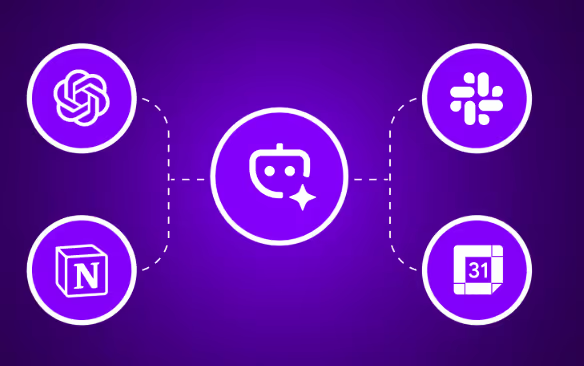
Ask Gauge's conversational AI agent provides instant analysis and recommendations without manual workflow building. GA4, GSC, and Semrush integrations connect AI visibility to real traffic data, while the content engine generates briefs, outlines, and full articles optimized for AI citation. Proven results include Sanctum's visibility jump from 16.7% to 47.5% in 6 months and LedgerUp's 1,713% increase from 1% to 17% in just 4 weeks.
Best For
Marketing managers and SEO leads who need to track AND act on LLM visibility — not just monitor it passively. Teams requiring real-time alerting, unlimited competitor tracking, and content execution capabilities within a single platform workflow.
Pros
- Broadest accessible coverage: Daily tracking across 7+ platforms including ChatGPT Ads and enterprise-tier Grok/Claude access
- Sentiment depth: Identifies weak AI framing at the prompt level, connecting negative positioning to specific content gaps
- Unlimited competitor tracking: Monitor competitor share of voice across all models without seat or domain restrictions
- Content execution engine: Generates AI-optimized briefs, outlines, and full articles that improve citation rates
- Conversational analysis: Ask Gauge agent handles insights and recommendations through natural language, eliminating manual reporting
- Marketing stack integration: GA4, GSC, Semrush, and MCP connections tie AI visibility to traffic outcomes and agent workflows
Cons
Growth plan ($599/mo) required for multi-model coverage beyond ChatGPT. Claude and Grok tracking limited to Enterprise tier, though most teams find the Growth plan's 6-model coverage sufficient.
Pricing
- Starter: $99/mo — 100 daily prompts, ChatGPT only, 3 articles, 3 seats
- Growth: $599/mo — 600 daily prompts, all major models, 18 articles, 10 seats
- Enterprise: Custom — all models + Claude + Grok, unlimited articles/seats, dedicated specialist
2. Peec AI — Best for Clean Sentiment and Position Analytics
Quick Overview
Peec AI tracks three distinct metrics that matter for brand health in AI search: Visibility (share of mentions), Position (ranking among competitors), and Sentiment (how AI describes your brand). The platform visualizes competitor performance through a quadrant chart that segments brands into Leaders, Niche Players, Laggers, and Controversial categories.
Trusted by 2,000+ marketing teams with $29M in funding, Peec AI emphasizes clean analytics over complexity. The MCP integration connects tracking data to Claude, Cursor, n8n, and custom AI workflows for teams that want automated responses to sentiment changes.
Best For
Mid-market marketing teams that want fast, actionable AI search analytics without learning complex workflow builders or wrestling with overwhelming dashboards.
Pros
The three-metric framework makes reporting simple — visibility tells you if you're mentioned, position shows competitive standing, and sentiment reveals how AI frames your brand. Marketing managers can explain results to executives without translation layers.
Peec AI offers unlimited users on every plan, removing seat-based pricing friction common in competitor tools. The platform provides actionable source recommendations like "G2 is regularly cited — ensure you have an optimized profile" that connect tracking insights to specific content actions.
Cons
Peec AI stops at monitoring — no content creation or execution layer to act on insights. Teams must build their own content workflows based on recommendations.
The 3-model limit on non-enterprise plans restricts coverage when teams need visibility across ChatGPT, Gemini, Perplexity, Claude, and newer platforms. Advanced analytics teams may find the simplified interface lacks the depth they need for complex competitive analysis.
Pricing
Starter plan covers 50 prompts across 3 models with 1 project at approximately €89/month. Pro expands to 150 prompts with 2 projects, while Advanced adds 350 prompts, multi-country tracking, and Looker Studio integration.
Enterprise tier provides custom pricing with access to all models including Claude Sonnet 4 and GPT-5 Search, API access, SSO, and dedicated support. The unlimited user model makes Peec AI cost-effective for larger marketing teams compared to per-seat competitors.
3. Otterly AI — Best Budget Entry Point
Quick Overview
Otterly AI tracks brand mentions and position across ChatGPT, Perplexity, Google AI Overviews, AI Mode, Gemini, and Copilot. The platform goes beyond basic monitoring with content audit features, crawlability checks, and content briefs. Trusted by 30,000+ marketing professionals, Otterly AI maintains a 4.8/5 rating and earned recognition as a Gartner "AI in Marketing Cool Vendor".
Multi-country tracking spans 67+ countries, making it accessible for global brands testing AI search visibility.
Best For
Teams getting started with AI search monitoring on a tight budget. Marketing managers who need basic visibility tracking without the complexity of enterprise platforms fit Otterly AI's positioning perfectly.
Pros
Otterly AI offers the lowest entry price in the category at $29/mo, making AI search monitoring accessible to small teams and startups. The content audit layer distinguishes it from pure monitoring tools by including crawlability checks and optimization recommendations. The large user base of 30,000+ marketing professionals signals strong product-market fit and reliable platform stability.
Multi-country support across 67+ countries provides geographic coverage that competitors often gate behind higher pricing tiers.
Cons
No content writing engine limits teams to briefs rather than full articles, requiring separate tools for content execution. Sentiment scoring lacks the depth found in Peec AI or Gauge, providing basic mention tracking without nuanced brand framing analysis. Teams typically outgrow Otterly AI as monitoring needs scale beyond basic visibility checks.
The platform positions itself as lightweight, which becomes a constraint for marketing teams requiring advanced analytics or content creation workflows.
Pricing
Starts at $29/mo for 15 search prompts with pricing scaling based on prompt volume and audit capacity. This makes Otterly AI the most accessible entry point for teams testing AI search monitoring before committing to higher-tier platforms.
4. Profound — Best for Enterprise Platform Coverage
Quick Overview
Profound covers 10+ AI platforms including Meta AI, DeepSeek, and Grok — the broadest platform coverage in the category. Its Agent Analytics feature tracks how AI crawlers read and interpret your site, while proactive Slack alerts notify teams when sentiment drops below -0.2 or inaccuracy exceeds 5%. The platform includes a no-code workflow builder (Agents) for AEO, content, PR, and demand generation.
Best For
Large enterprises and marketing engineering teams comfortable building custom workflows. Not ideal for teams wanting a simpler, more guided experience.
Pros
Profound offers the broadest AI platform coverage with 10+ models tracked, making it unmatched for comprehensive visibility monitoring. Agent Analytics is a standout differentiator that shows which AI crawlers are hitting your site and what content they're reading — valuable intelligence for technical teams. The proactive sentiment alerting via Slack keeps teams informed when brand framing deteriorates without manual monitoring.
Cons
The Agent is a no-code workflow builder rather than a conversational interface, requiring more manual effort to turn insights into action. Profound lacks GA4, GSC, Semrush, or ad data integration in the agent layer, limiting its ability to connect AI visibility to broader marketing performance. Teams must invest significant time building custom workflows to translate monitoring data into AEO improvements.
Pricing
Starter: $99/mo (monthly) / $82.50/mo (annual)Growth: $399/mo (monthly) / $332.50/mo (annual)Enterprise: Custom pricing available
5. Scrunch AI — Best for SaaS and B2B Tech Teams
Quick Overview
Scrunch AI launched in 2024 as a specialized AI visibility platform targeting SaaS and B2B tech companies. The platform tracks brand presence across 7+ AI engines including ChatGPT, Claude, Perplexity, and Meta AI, earning a 4.6/5 rating from 72 G2 reviewers. Its unique angle is AI bot crawling behavior tracking, which shows how AI crawlers interact with your site beyond standard mention monitoring.
Best For
SaaS and B2B tech companies that want to understand how AI bots crawl and cite their content. Teams in vertical software, dev tools, or B2B services will find Scrunch's industry focus and bot behavior insights particularly relevant for their content strategy.
Pros
AI bot crawling behavior tracking sets Scrunch apart from basic mention-monitoring tools. The platform's intuitive dashboard consistently receives praise from G2 reviewers for its clean interface and actionable insights. Citation monitoring tracks which specific content pieces get referenced in AI answers, helping teams identify their most AI-friendly assets.
Cons
Weekly prompt tracking on lower plans makes Scrunch less real-time than daily competitors like Gauge or Peec AI. The platform lacks a content creation or writing engine, stopping at monitoring without execution support. Sentiment analysis depth is limited compared to specialized tools like Peec AI's three-metric framework.
Pricing
Discovery plan starts at $49/mo but excludes AI prompt tracking entirely. Standard tier at $99/mo includes 25 prompts tracked weekly across ChatGPT only. Pro plan costs $182/mo for 50 prompts with broader model coverage, while higher enterprise tiers are available for larger teams.
6. Evertune — Best for Enterprise Brands Connecting AI Visibility to Paid Media
Quick Overview
Evertune positions itself as an AI marketing platform for the "whole marketing team," tracking brand visibility across major AI platforms while uniquely offering AI retargeting through The Trade Desk and Index Exchange. The platform's EverPanel provides behavioral data from 25 million users to reveal actual AI search prompt volumes, not just model queries. Shopping Intelligence tracks brand visibility specifically in ChatGPT product recommendations — a standout feature for e-commerce brands.
Best For
Enterprise brands and large agencies that want to connect AI visibility insights directly to programmatic advertising campaigns. The platform excels for consumer brands and e-commerce companies that need to bridge the gap between AI brand monitoring and paid media activation.
Pros
Evertune is the only platform in this category offering AI retargeting capabilities, allowing brands to run programmatic campaigns on AI citation sources through established ad exchanges. The 25 million user behavioral panel provides real-world AI search insights rather than synthetic model testing. Shopping Intelligence delivers specific value for product-focused brands tracking recommendations in ChatGPT's shopping features.
Cons
No public pricing creates accessibility barriers for mid-market teams evaluating options. The platform focuses on strategy recommendations without a content writing engine, requiring separate tools for content execution. External reviews describe the monitoring capabilities as less technically sophisticated than competitors like Profound.
Pricing
Custom enterprise pricing only — contact sales for quotes. The enterprise-only positioning limits access for smaller brands and marketing teams evaluating multiple options with transparent pricing.
Summary Comparison Table
Why Gauge Leads the Pack for LLM Brand Tracking
Most LLM tracking tools stop at monitoring — telling you where you appear and how you rank. Gauge connects tracking to content creation to measurement, closing the loop from insight to action. When Vellum increased visibility from 1.4% to 40.3% in seven months, they weren't just watching dashboards — they were executing content based on what the data revealed.
The Ask Gauge agent handles analysis conversationally without manual workflow building. Instead of clicking through reports to understand sentiment drops, you ask "Why did my brand sentiment decline this week?" and get actionable recommendations instantly. LedgerUp saw 1% to 17% visibility in four weeks using this approach — a 1,713% increase driven by data-to-content execution.
GA4, Google Search Console, and Semrush integrations tie AI visibility to real traffic and business outcomes. While competitors track AI mentions in isolation, Gauge shows how LLM visibility correlates with actual website traffic and conversions. This connection matters when justifying AI search investments to executives who care about revenue impact.
At $99 monthly, Gauge starts accessible while enterprise-only alternatives gate basic functionality behind custom pricing. Profound requires $399 monthly for multi-model coverage; Evertune offers no public pricing at all. Gauge democratizes comprehensive LLM tracking for mid-market teams that need results, not just reports.
Key Takeaways
• Visibility and sentiment are separate signals — a brand can be mentioned frequently but framed poorly, or absent entirely from relevant conversations
• Most tools only monitor, few enable action — tracking brand mentions is table stakes; the value comes from connecting insights to content execution and measurement
• Tool choice depends on team size, budget, and execution needs — budget-conscious teams start with Otterly ($29/mo), mid-market prefers Peec's clean analytics, enterprises need Profound's broad coverage
• Gauge closes the full loop from insight to impact — the only platform that tracks mentions, analyzes sentiment, creates optimized content, and measures results in one workflow
• Integration depth separates leaders from followers — tools that connect AI visibility data to GA4, GSC, and existing marketing stacks deliver actionable business intelligence, not just vanity metrics
FAQs
What is an LLM tracking tool?An LLM tracking tool queries AI models like ChatGPT, Gemini, and Perplexity with specific prompts, then records whether and how your brand appears in the generated answers. These tools measure three core signals: visibility (whether you're mentioned), position (your rank among competitors), and sentiment (how the AI describes your brand). Gauge stands out by connecting these tracking insights directly to content execution through its built-in content engine.
How do I choose the right LLM brand tracking tool?Match the tool's prompt volume and model coverage to your team's monitoring needs — daily tracking across multiple models costs more but provides better competitive intelligence. Prioritize platforms with sentiment analysis over basic mention detection, since how AI frames your brand matters as much as whether it mentions you. Gauge covers the full workflow from tracking to sentiment analysis to content creation and measurement in one platform.
Is Gauge better than Profound for LLM tracking?Profound offers broader raw platform coverage with 10+ AI models versus Gauge's 7+ models. Gauge adds a conversational AI agent, integrated content engine, and direct GA4/GSC/Semrush connections that Profound lacks. Gauge is also more accessible at $99/mo versus Profound's $399/mo Growth plan. See the full Gauge vs Profound breakdown.
How does LLM tracking relate to SEO?AI search and traditional search are correlated because AI models use web retrieval to generate answers, but LLM tracking adds a crucial layer SEO tools miss: how AI interprets and frames your brand from the content it finds. Strong search rankings don't guarantee positive AI sentiment or prominent positioning in generated answers. Gauge integrates with GSC and Semrush to connect both traditional and AI search signals in one dashboard.
If my SEO is strong, do I still need LLM tracking?Yes — strong SEO performance doesn't guarantee AI visibility or positive sentiment in AI-generated answers. AI models weight content relevance, authority, and citation sources differently than traditional search engines, often prioritizing different content formats and sources. Gauge identifies specific gaps where your high-ranking SEO content isn't getting cited or is being framed poorly in AI responses.
How quickly can I see results with LLM tracking?Tracking data appears immediately after you set up your prompts and competitors. Visibility improvements depend on how quickly you can execute content changes based on the insights. LedgerUp achieved 1% → 17% visibility growth in under 4 weeks using Gauge's integrated tracking and content creation workflow.
Related Blogs