How Agencies Can Use AEO Audits to Close Clients

For agencies, any chance to differentiate from competitors is a major advantage. Unique services generate more revenue, and AEO/GEO is that opportunity right now. Pitching gets a lot easier when you can proactively surface a prospect's weaknesses, particularly against their competitors, using real data they've never seen before. This article provides a step-by-step structure to help agencies close clients using AI visibility audits.
Why an Audit Is Important for Agency Pitching
Most prospects don't know they have an AEO problem. They see their Google rankings holding steady and assume they're covered. Meanwhile, ChatGPT handles over 2 billion queries per month, and Google AI Overviews now appear on 13%+ of all SERPs.
The average AI query is 11.1 words long, compared to 2-3 words for a traditional Google search. These are detailed, intent-rich questions, and AI models scan 50-60 results per query to synthesize answers. Your prospect's strong Position 3 ranking in Google means very little if their content isn't structured to be retrieved and cited by LLMs.
Slide decks about "the rise of AI search" don't create urgency. A prospect's own visibility data, benchmarked against their top three competitors, does. Data-first pitching converts because it makes the problem specific, competitive, and personal.
What to Measure in an AI Visibility Audit
These metrics form the backbone of any AEO audit. You need all of these metrics together because each one tells a different part of the story.
Brand Visibility Rate
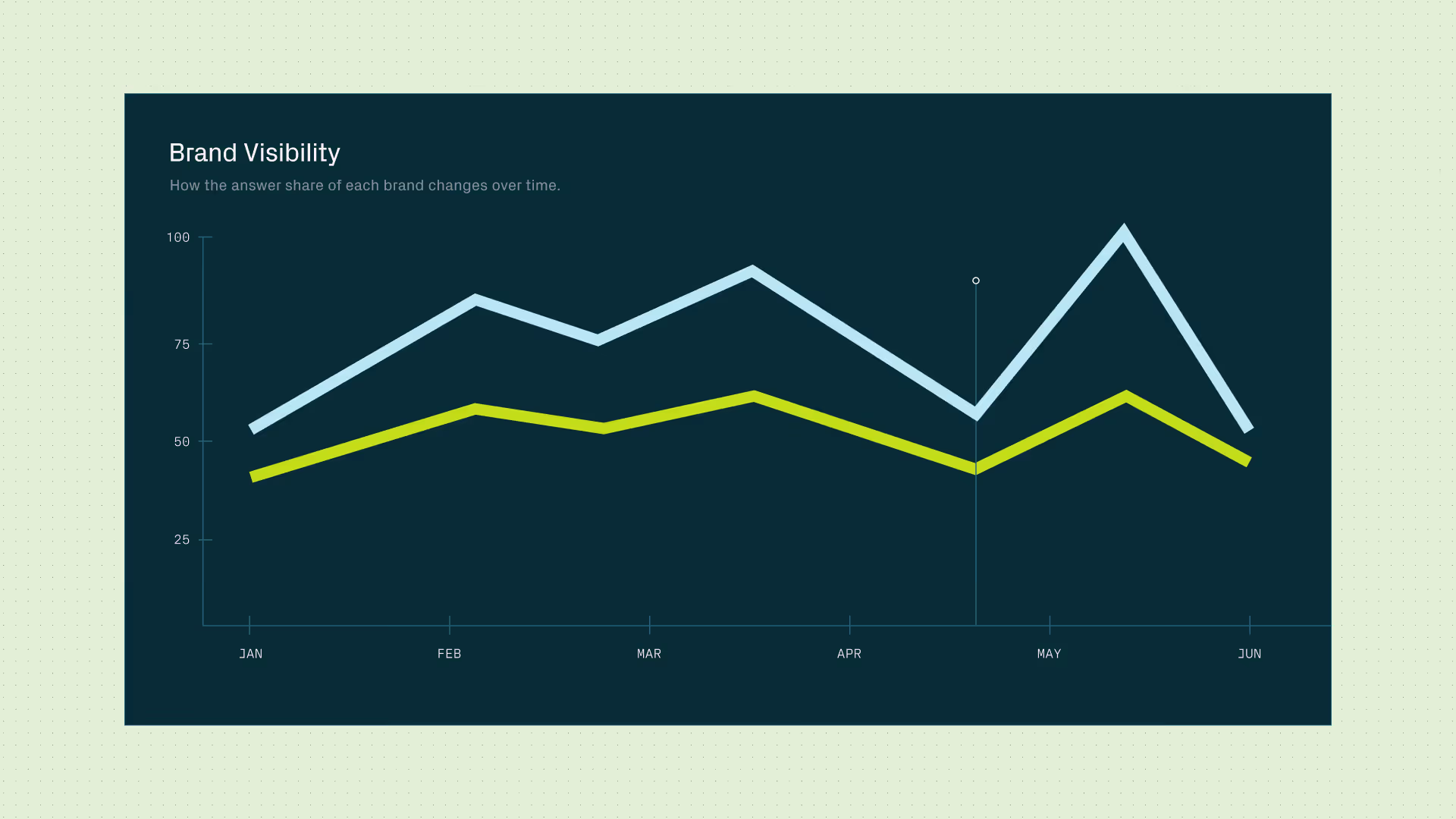
The percentage of AI-generated answers that mention the brand name across all tracked prompts. This is the top-line number you'll open every pitch with. It's the fastest way to make the competitive gap visceral. A brand sitting at 2-5% while competitors hold 30%+ is losing mindshare in a channel it can't even see, and that spread tells the prospect exactly how much ground they need to recover.
Domain and URL Citation Rate
How often the prospect's domain (and specific URLs) get pulled as sources by AI models. A page can be cited as a source without the brand name ever appearing in the generated answer. Citation rate tells you whether AI is reading the prospect's content. It doesn't tell you whether the prospect is getting credit. A page with a high citation rate but zero brand mentions is effectively doing unpaid research for the AI model, feeding it useful information that gets synthesized into answers attributed to no one.
URL Mention Rate
URL mention rate measures, of the AI answers that cite your URL as a source, what percentage actually name your brand in the answer text. This metric exposes a common problem: AI models frequently cite your content to generate their response but strip your brand name from the text the user sees.
The gap between citation rate and mention rate reveals how much invisible influence your content has. A high citation rate paired with a low mention rate means your content is shaping AI answers without your brand getting credit. Refreshing content with brand-linked examples, proprietary data, and first-party perspectives makes it harder for models to strip your brand from the answer.
Model-Level Breakdown
The same metrics are segmented by ChatGPT, Perplexity, Gemini, Copilot, Google AI Overviews, and other AI models. Model-level data reveals blind spots that aggregate numbers hide.
Technical Blockers
JavaScript rendering issues, robots.txt blocks, missing Bing indexing, and absent schema markup. These are immediate, fixable findings that create urgency in the pitch. "Your pricing page is blocked by robots.txt, so no AI model can read it" is the kind of concrete, surprising finding that moves a prospect from curious to committed.
Best Pitch Structure (Step by Step)
Best Pitch Structure (Step by Step)
Step 1: Analyze High-Level Standing vs Competitors
Open with the competitive data. Show brand visibility rate by model for the prospect and their competitors, side by side. The numbers should be the first thing the prospect sees.
The pitch line is simple: "Your competitor appears in 40% of ChatGPT answers for your category. You appear in 2%." Pull a few verbatim AI-generated answers to help them understand how AEO works. When a prospect reads an AI response that calls their competitor "the leading platform" while their own brand gets a passing mention as "another option," the competitive instinct kicks in fast.
Step 2: Analyze Key Topic Categories
Drill into visibility and citation rate by topic cluster. Most brands aren't uniformly invisible. They're winning in some categories and completely absent from others. Showing which topics the prospect dominates, which they're competitive in, and which they don't appear in at all turns a vague problem into a prioritized roadmap.
Step 3: Analyze Top Domains Being Cited
Show which domains AI models are pulling as sources for the prospect's category. The results are usually surprising. Reddit threads, competitor blog posts, and third-party review sites routinely outrank the prospect's own pages as citation sources. Help the potential client understand what sources are dominating the space.
Step 4: Explain the Retrieval Chain (Why This Is Happening)
This is where you educate the prospect on why they're invisible. The framing is important: this isn't an algorithmic penalty. It's a structural content and technical problem, which means it's fixable.
Gauge's citation optimization framework breaks AI retrieval into five steps, and each one represents a point where the prospect's content can fail.
The User Query AI prompts look nothing like Google searches. The average AI-generated query runs 11.1 words vs 2-3 for Google, full questions with context and qualifiers baked in.
The Search Decision The model decides whether training data can answer the question or whether it needs live web retrieval. Commercial, product, and category queries almost always trigger retrieval. That's where citation optimization opportunity lives.
Query Rewriting When retrieval triggers, the model writes its own search queries, longer and more specific than the original prompt. Models run roughly 2.7 searches per user prompt, inserting terms like "tools," "2026," "best," "comparison," and "platforms." Listicles and comparison pages surface more often because they match this query language.
RAG Chunking Retrieved pages get broken into 200-1,000 token chunks, each scored independently for relevance. Where the answer sits and how self-contained each section is determines whether your content survives this step.
Citation Assignment The model synthesizes the top-scoring chunks into a final answer and assigns citations. Only selected passages become citations. Content structure moves citation rate significantly, independent of domain authority.
Step 5: Show How Writing Content Closes the Loop
Every finding in the audit points to the same fix: content. AI models cite what they can find, chunk, and extract a clean answer from. If the prospect's content isn't structured for that, it won't get cited regardless of how strong their SEO is.
This is where your agency's expertise becomes the pitch. Writing content optimized for AI retrieval requires a different structure than traditional SEO content. That's a specialized skill, and most prospects don't have it in-house.
This is then the perfect time to pitch your track record. Share your most successful client AEO transformations, leveraging the metrics I explained above.
Key Takeaways
The audit-first sales motion only works if you can run audits without burning hours on manual prompt testing. Gauge's Agency Mode solves this with a specific workflow: $300/month per active client instance, and pitch workspaces included at no extra charge.
Before a prospect commits, you set up a pitch workspace, configure a couple hundred prompts for their category, and run them across every major AI model. The output is everything you need for the five-step pitch: brand visibility rate by model, competitor comparison data, and citation rate by URL & domain.
Once a client is active, Gauge handles the content side too. The platform's content engine turns visibility gaps directly into briefs, outlines, and fully written articles optimized for AI retrieval.
When the prospect signs, the pitch workspace converts directly to a full daily-tracking client instance. No data loss, no re-setup. The baseline from the pitch becomes the starting point for ongoing measurement, and the $300/month per client kicks in only when they're paying.
FAQ
How much should agencies charge for GEO services?
Most agencies price GEO retainers between $2,000 and $8,000/month depending on the number of topic clusters, volume of content production, and technical complexity. The pitch workspace audit itself can be positioned as a free diagnostic (your cost is zero through Gauge) or as a paid audit ranging from $500 to $2,000. Start with a 3-month minimum engagement to allow enough time for results to compound.
How long until a client sees GEO results?
Faster than SEO. Content and technical optimizations typically show measurable visibility changes in 2-8 weeks. Gauge clients have documented 2x visibility in 2 weeks, 5x in 4 weeks, and sustained growth from 1.4% to 40.3% over 7 months. Set client expectations at 4-6 weeks for initial movement and 3-6 months for significant, sustained gains.
How is GEO different from SEO?
SEO optimizes for ranking positions in a list of links. GEO optimizes for being cited and mentioned in AI-generated answers. The content principles overlap (quality, structure, authority), but the mechanics are different. AI models rewrite queries, chunk content via RAG, and assign citations through a synthesis process that traditional SERP ranking doesn't account for. A page can rank #1 on Google and be invisible to ChatGPT if it's not indexed in Bing or structured for RAG retrieval.
What do I say when a client already has Ahrefs or Semrush?
"Ahrefs and Semrush track where you rank in a list of links. They don't track whether ChatGPT, Perplexity, or Gemini are mentioning your brand in their answers. Those are two different distribution channels, and right now you have zero visibility into one of them." Position GEO tracking as complementary, not competitive. The client keeps their SEO tools. Gauge tracks the AI layer they can't see.
How do I explain GEO to a skeptical CMO?
Lead with the numbers: 2 billion+ queries per month on ChatGPT alone, 13%+ of Google SERPs now showing AI Overviews. Then make it competitive: "Your competitor shows up in 40% of AI answers for your category. You show up in 2%. That's traffic and brand impressions flowing to them that you can't even see in Google Analytics." Skeptical CMOs respond to competitive data and revenue risk, not trend narratives. Show them the audit. The data does the convincing.
Related Blogs
 Expect Higher Visibility on Grok. Lower on Perplexity. A Study of Brand Mentions from 17M+ Answers